
Table of Contents
- Why blogs are different from website copy
- Why are blogs so useful?
- When you should use AI in blogging
- When to avoid AI in blogging
- Risks if you do use AI to write blogs
- Things to watch out for if you do use AI to write blogs
- Opportunities in AI search
- TL;DR
- Finally, I know what you’re thinking…
- Real-life inspiration beats AI inspiration
Using ChatGPT to write your blogs is fast, easy, free … and it never makes a typo! So what’s the problem with using AI to write blogs?
Up-front declaration: I’m not a copywriter who thinks that AI is the enemy. It presents massive opportunities, but only if you know how to use it properly. Otherwise, it can be a huge time-suck and, at worst, do serious damage to your brand and business.
Why blogs are different from website copy
Real quick: I’m talking about blog articles, not website copy.
Do not use AI to write the words on your website.
By the time a visitor lands on your blog article, they’ve already shown an interest in your brand or the topic you’re covering (preferably both).
But website visitors? They’re quickly scanning your site and looking for a reason to take action or click away. Bland, generic content that doesn’t say anything will force the latter.
Every single one of the 200-600 words on each website page is precious and designed to captivate and convert your visitor into taking action. That means that your website copy has to be human-written and reflect your true brand voice. No corner-cutting.
But blogs are long, hard to write and require so much research!
Yep. And that’s exactly why you need to create them yourself, to stand out from everyone else who’s generating AI slop and actually write something that’s worth reading.

Photo by Ilargian Faus on Pexels
However, you can use AI to maximise the potential of your blogs AND speed up some of the less creative elements.
Why are blogs so useful?
Blogs are a business’ secret weapon. They draw in potential clients, give you a chance to showcase your expertise, skills and experience, and offer shareable content that grows your reach.
Blogs are also the ultimate SEO tool, giving you the perfect opportunity to boost your SEO without editing your website copy.
And now in the era of AI, they are the perfect way to educate LLMs on your brand so they know how to spotlight you in their answers.
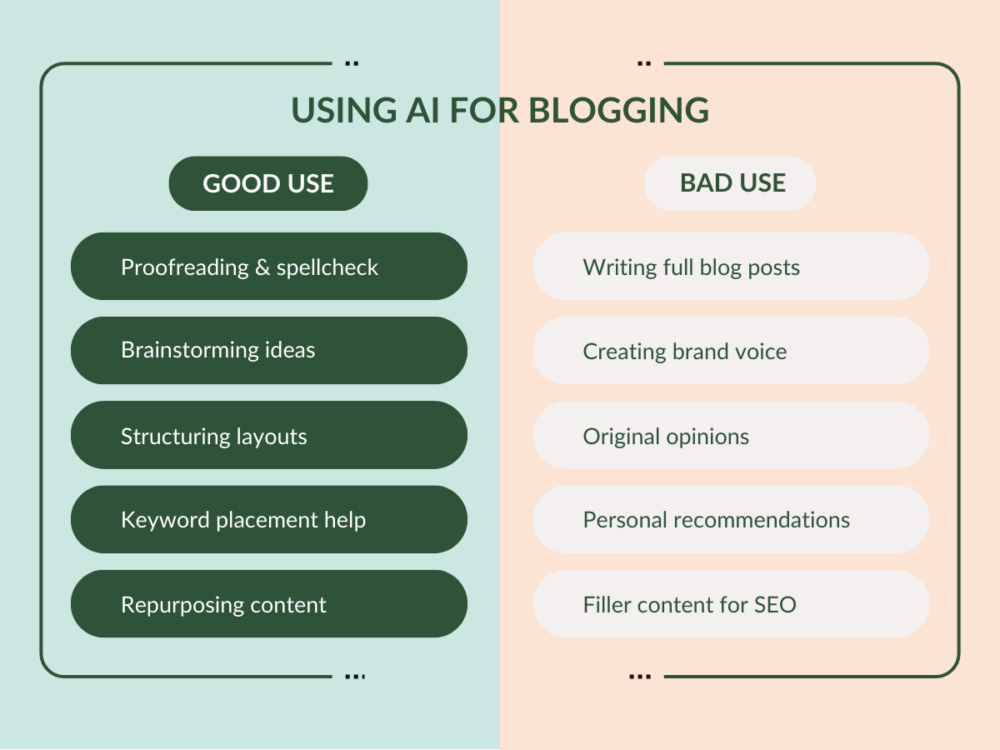
Take a look at the list of when you should and shouldn’t use AI for blogging (or skip straight to the TL;DR at the bottom).
When you should use AI in blogging
Let’s start with a list of the many ways you can use AI to supercharge your blogs.
Proofreading & spellcheck
AI is the quickest editor on earth and it can highlight spelling mistakes, typos, and poor grammar if you give it the right directions. Just be careful if it offers a rewrite, as you’ll need to make sure it fits your brand voice.
Brainstorming
AI can help spark ideas on how to finish an article, additional content that would be useful to the reader or even a concept for a supporting set of articles to strengthen your blog’s architecture. Just ask it for suggestions and choose the best ones from the list.
Layout & structure
AI tools can format your blog into sections where you simply write the copy, creating an easy-to-follow template that’s more like a worksheet than a terrifying blank page.
Keyword placement
If you don’t know how to effortlessly fit a keyword into a sentence without giving ‘click buy now’ vibes, ask AI for suggestions on keyword placement. (See what I did there?)
Formatting notes
Ask AI for guidance on H1, H2, H3, H4 headers so that your blog is SEO-ready from the get-go.
Light editing
Cut a paragraph down. Expand a sentence. Rewrite for clarity. Just make sure you reread it and ask yourself, “does this sound like something I would say out loud?” Or has it lost its humanity?
Glossary
If there’s content that doesn’t require a human touch, e.g. a long, simple list of vendors, equipment, etc. without recommendations or personal opinions, then definitely use AI. It will be way quicker than you doing it yourself. Just double check all of the information before hitting publish, as ChatGPT doesn’t have a stake in whether the info is accurate (but you do)!
Spinning your blog into more content
This one is an effort-maximising gem. Once you’ve written your blog, feed it into ChatGPT and ask for pull quotes to share on social media. One blog could create dozens of fun Threads posts, copy for a few Insta carousels or a YouTube video script. I will definitely be doing all of the above for this blog!
If AI can save you time* doing any or all of the above, go for it. Then use that saved time to write another blog and DOUBLE your content output!
* Just be aware that professional copywriters (including many from the Pepperstorm team) say that doing some or all of these manually is actually faster and easier.
When to avoid AI in blogging
Full content creation
Anyone with access to a ChatGPT account (so everyone) can now generate a fluent blog on any subject in the world. That’s why the internet is littered with AI slop.
The only things that people now read are unique, human-written and edited content. This is something you can’t hack – you need to be a good writer (or hire one haha).
Original opinions
AI is great for brainstorming (see above), but you’re only going to get original and interesting content if you input original and interesting information in the first place.
AI has no lived experience so you need to draw on your own for the kernel of all of your ideas, otherwise it will be derivative by default.
Expanding content for the sake of expanding
Writing a 2500-word opus feels great. You’ve become an author in an afternoon! But you should only hit ‘Publish’ if you’re confident that every section is relevant to the topic and will be interesting and/or useful to the reader.
Why? Because Google and AI search now rank for clarity and usefulness, not just length and depth.
Some topics not only deserve but absolutely require a large piece of cornerstone content, like an overview of the location you cover or a specialist service you offer. (Or, yes, a meditation on whether you should use AI for blogging…) This is the type of article that’s going to signal to search engines, LLMs and your readers that you really know your onions. And if you split the post up into easily digestible sections with the correct headers then Google and chatbots will scrape and serve up as answers.
However, not every topic needs such a deep dive. If you can answer a question in 700 words instead of 1000, do it. Your audience will thank you for it. And Google and AI search will reward you.
Brand voice
AI is fantastic at aping human voices, not creating original style. Ask ChatGPT to write a blog in the voice of Matthew McConaughey and alright alright alright you’ve got yourself a winner.
If you want your audience to become familiar with your voice, style and sensibilities, be unique. That’s all that readers and search engines value anyway!
Personal recommendations
Your audience wants your thoughts on the services and products you provide. They pay money because they value your opinions, expertise and experience.
Let’s say you work in travel. Anyone can ask ChatGPT ‘where are the best sunset spots on the Amalfi coast’ and get a general overview. But people hire photographers, wedding planners, travel guides, etc. to learn your favourite spots that you know about – so that’s what you need to share on your blog.
Risks if you do use AI to write blogs
Authenticity
Readers are getting better at recognising AI copy (look out for em dashes, a blandly positive tone, stop-start scansion, etc.).
Revealing that you’ve outsourced your brand voice to AI is kryptonite for brand authority and building trust, especially in a very personality-driven industry, e.g. wedding photography.
Getting found out
Just like a student using ChatGPT to write an essay, when it comes to the final exam (or in your case, hopping on an intro call), if you’ve used AI to write your blog and it has included points that you don’t know, think, or believe that your client asks about…you’ll receive a red F stamped on your paper. (Translation: a really embarrassing moment when they ask for a refund.)
Blogging to get found on Google search
It’s no coincidence that Google added Experience to its E-E-A-T list around the time that ChatGPT was launched.
AI doesn’t have lived experience, and that is exactly what separates your content from the bots. It’s also what your audiences come to your brand looking to find.
Trying to boost your SEO with purely AI-generated content will not work (the team at Google are way smarter than that).
Blogging to get featured in AI answers
LLMs are looking for trusted sources and authority to rank in their answers. If you’re just using AI and not putting your own ideas, experience or brand voice in, then it will ignore it and reference a competitor who does.
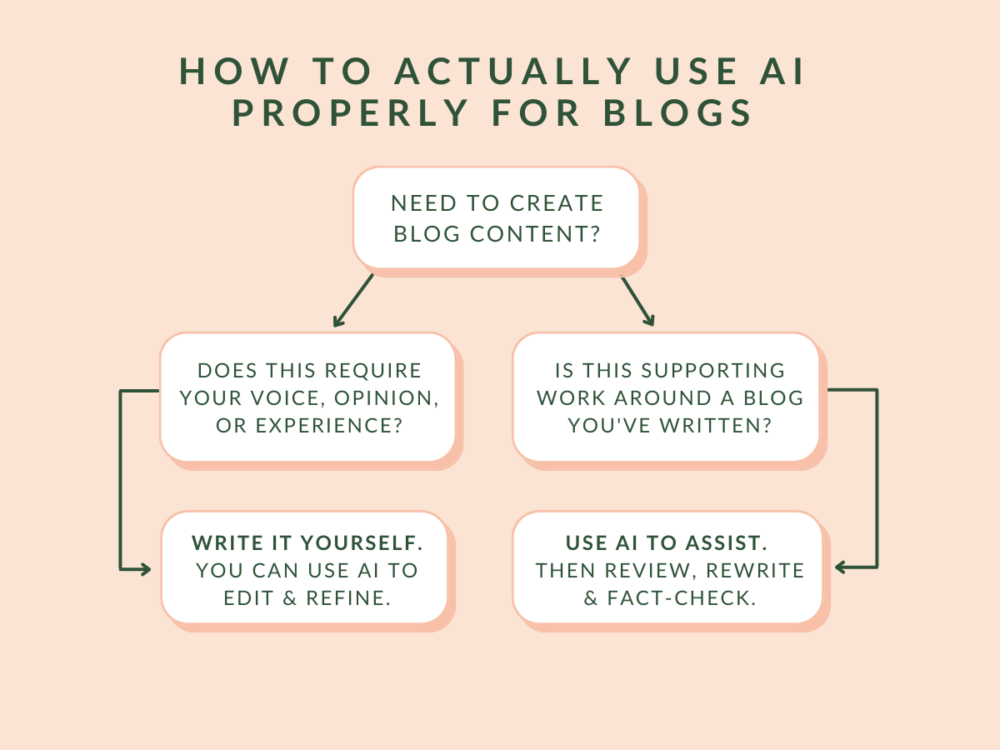
Things to watch out for if you do use AI to write blogs
I know some of you are going to ignore me and just use ChatGPT to create your blogs anyway.
So, like a worried parent giving their teenager a speech on abstinence and then slipping a packet of condoms into their backpack before they leave for a holiday (would ChatGPT make up that simile?!), I’m going to tell you what to look out for if you insist on using AI to create blogs.
Confirmation bias
AI is very good at convincing humans that they’re right, even when they’re wrong. AI tools can quickly create seemingly generic content that reads perfectly well but isn’t actually saying what you want it to say, which leads to pretty obvious negative effects on your brand.
Platform consistency
You should have the same voice across all of your content (website, Insta, videos, blogs, etc.). Talking in one tone on Insta because you like writing short captions will help people engage with your brand. If they explore your blog and see flat, AI-generated copy then this will be jarring and can immediately erode trust.
AI makes mistakes
Famously so. If you give wrong advice on your blog (broken links, outdated vendors, incorrect pricing, wrong directions, etc.), then this is terrible for brand trust and SEO.
Wabi-sabi
The reason that purely AI-generated copy is uncanny to humans is that it’s a form of perfection. And perfection doesn’t exist. Humans are flawed, opinionated, raw, and real – and that’s what other humans are attracted to, especially in written content.
I’d rather read an engaging, thoughtful blog with a few spelling errors (or even an opinion that I don’t agree with) than a perfectly written blog with exactly the same amount of words in each sentence that doesn’t say anything. So would most people. And, funnily enough, so would Google and AI search. Which is exactly why they rank them above AI-generated content.
Opportunities in AI search
AI isn’t just about content-maximising, efficiency and streamlining manual tasks. It’s about discovery.
AI search is going to be huge in 2026 and beyond, especially in industries that require a lot of planning such as travel, events and weddings.
More and more couples are using ChatGPT to plan holidays, weddings and elopements. Getting your brand to show up as an answer is like being at the top of Google Page 1, but with no one beneath you.
The way to do this is to optimise your website for AI search. Fewer will click through to your site from AI answers (as opposed to traditional Google search), but the ones who do will already be sold on your brand.
The way to get the robots’ attention? Be human.
TL;DR
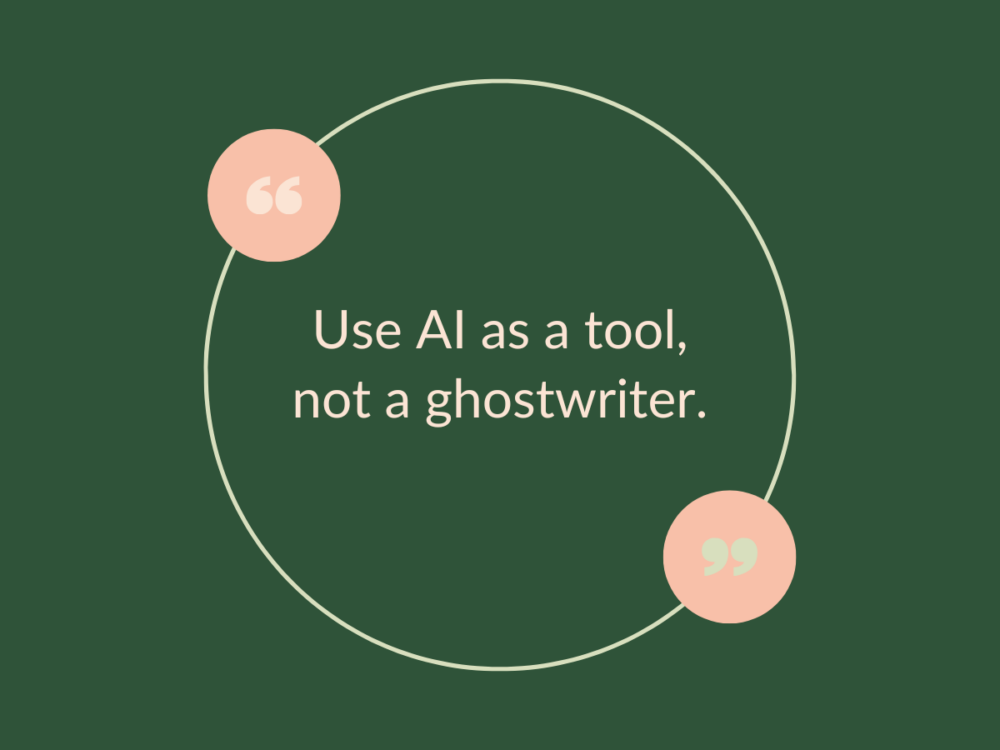
Definitely use LLMs if you know how to use them properly, and they save you time. Do not outsource your entire brand voice and content strategy to a bot.
You cannot outsmart Google and AI by using AI to game their own system. But you can shine in their results simply by being yourself.
Human-written and edited, original, brand-voice content will get you read, referenced, and noticed.
Finally, I know what you’re thinking…
Did I use AI to write this blog?
Sure did!
I used it to proofread, spellcheck, and suggest a few alternative headers. It did a great job, even adding a keyword on a few subheadings that I hadn’t thought of.
Then I asked for a list of keywords. Some of them were good, but some felt a little crowbarred (hello ‘AI content for service-based businesses’!), so I’ve used a mix of my own with a few AI suggestions.
But that’s to be expected. It doesn’t know me like I know me. And it doesn’t know you, my audience, like I know you.
Did I use AI for inspo? Nope…
Where did the inspiration for the article come from?
The idea for this blog came from an email chat I was having with the fantastic Brendan Creaser, a photographer and educator who we worked with a few years ago. Brendan appreciates the power of blogging and SEO – so much so that he asked us to create 52 blogs for his brand (yep, 1 per week for a year!).
It was an idea concocted by him and his business coach, my friend Jai Long, and it was one that has paid frickin’ dividends.
Brendan was ranking on Page 1 within a few months and was soon able to step away from constant daily posting and move to a Google-led, passive-lead strategy.
Four years later, and these Mornington Peninsula blogs are still bringing in leads:

We love staying in touch with our clients. The other day, Brendan and I were having an email chat about LLMs and blogging.
He asked me for an ‘Objection List’ re: LLM blogging. I had so much fun writing the reply that I decided to expand it into what you’re reading now.
Real-life inspiration beats AI inspiration
I find that this kind of real-life inspo always kindles more interesting and creative responses from my brain, giving me an angle on a subject that makes me want to really sink my teeth into it.
Sure, had I asked ChatGPT to suggest a list of topics regarding AI and content creation, then ‘Should you use AI to write blogs?’ may have featured.
If it had, it would have also supplied the article in seconds – saving me half a day of hard work! But would you have made it to this part? Doubt it.
Would it have written engaging enough material that I’m going to spin into Instagram, Threads, and YouTube content? Nah.
Would it be well on its way to ranking on Google and AI search? My money is on no.
And here’s the real question… Let’s say you were browsing our blog and spotted an AI-generated article with the same title as this one. Would you have been inspired to hire us so that you could outsource blogging? Definitely not.
As a writer, I enjoy spending time tapping away at my computer on a subject that fascinates me.
But as a business owner, I also know that there’s a financial reward to content creation.
Judging from previous deep dives that I’ve written, this one piece of content is almost certainly going to attract a client or two. To be honest, it will probably be a lot more than that over the next few years (SEO is a gift that really does keep giving – just ask Brendan).
All for 3-4 hours of my time? No ad campaign in the world will deliver that kind of ROI. Which is why content and SEO has never been more crucial to a brand’s growth strategy.
But guys… We write blogs for a living, so you don’t have to.
Send us a little info on your brand, and we’ll chat with you about how blogging can help your business grow in this new era of the internet.