

Keywords, blogs, landing pages… that’s the sexy part of SEO. Well, we think so, hence our career choice. But there’s a whole list of dull, unglamorous SEO tasks that can catapult you up the rankings – mainly because hardly anyone else bothers doing them.
If you want an outsized edge over your competitors and you don’t mind a bit of headphones-on, locked-in SEO work, then here are 5 ways to boost your SEO.
Stay awake!
📝 Psst. How boring is your SEO? Grab the free scorecard at the bottom and find out in 5 minutes.
1. Answer the questions your clients actually ask
Your FAQ page is a hugely underrated SEO win – especially for AI search.
Chatbots are hunting for unique, detailed, human-written responses to serve up as ready-made answers.
Be the brand that hands them the perfect response on a plate to get featured in AI answers.
How to find the best FAQ questions to feature on your site
The best way to find out what clients actually ask is to scrape your inbox, DMs, consultation call scripts – anything where your ideal clients are trying to find out more about how your business works.
I know there’s a temptation to just write a generic FAQ, steal an idea from a competitor or (God forbid) use template copy. But chatbots will ignore this in favour of another business that has put in the extra effort to create unique content that actually gets to the heart of what people want to know.
Example:
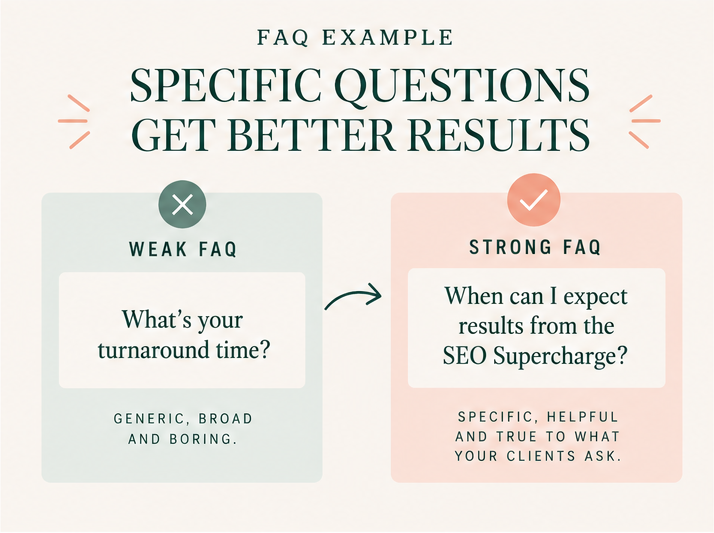
Weak FAQ: What’s your turnaround time? This is generic, broad and boring.
Strong FAQ: When can I expect results from the SEO Supercharge? This is specific and actually answers a question that people want to know.
Once you’ve created a strong FAQ page that’s optimised for AI search, it doesn’t have to stop there. Every time you spot a trend in new clients asking the same type of questions, update your FAQ page with fresh content.
→ Do this today: Pull the last 5 questions a client asked you before booking and turn them into new FAQ entries.
2. Interlink your blogs and webpages
Every unlinked page is a dead end. Dead ends = dead leads.
Sprinkle some elixir of life into your website by hyperlinking related content – it turns those dead ends into routes that lead straight to a booking.
What are orphan pages?
Orphan pages are webpages that no other page links to. This makes them hard for Google to find, so they don’t offer much in the way of SEO value.
There are a few times when you may want an orphan page, for example if you only want a hyper-specific audience to see a secret offer. But if you want Google, AI and your potential clients to notice these pages, then make sure they have clear and findable links throughout your site.
How many links should a blog post have?
Blog posts should have 2-3 internal links and 1 external link (if relevant) per 1,000 words and ALWAYS end with a call-to-action link to a related post, service page or contact form.
How many links should a webpage have?
Webpages should have at least one link to a contact form and one link to a related webpage or blog post, e.g. About should lead to Services, Services should lead to a deep-dive blog post.
How blog posts and webpages can work together
Interlinking blog posts and webpages creates a content cluster that signals to Google and AI that you are an expert on a particular subject. Choose a topic to focus on, e.g. a specific location or service you offer, and create a landing page with several supporting blogs that explore and outline the topic in greater detail. Place clear links between each of these posts and the page, and make sure your reader can easily get in touch wherever they are on the site. Bonus points for adding a downloadable PDF as a lead magnet to capture their email and turn them into a hot lead.
This is best SEO practice for all new blog posts and pages – however, you could also revisit all of your existing content and make sure you have clear, unbroken links throughout.
Tedious? Yes. Worth it? 100%.
→ Do this today: Open your 3 most-read blog posts and add at least one link to a relevant service page in each.
3. Write alt text like a human
It’s time to lose “DSC_4732” as your image alt text.
Try “Newlyweds embracing on a Maui beach at sunset” instead.
This small fix does more than you’d think for both accessibility and search. Google rewards you by showing your images in its search results and sees your website as a serious player rather than a hobbyist.
Why alt text matters beyond SEO
Google loves quality alt text – but so do people who may not be able to access your site in the way most people can, whether that’s due to slow loading times, poor Wi-Fi, vision impairment, etc.
Improving your accessibility caters to a wider audience and shows Google that you care about your visitors.
How to write good alt text
The best alt text describes an image in a way that someone who cannot see the picture can understand.
The best formula for writing alt text is subject + action + setting. For example, “Bride and groom kissing at the altar of a daytime Valencia wedding.”
Get descriptive without overloading. And don’t keyword stuff for the sake of it – only include keywords if they help the description.
If you work with lots of images, e.g. if you’re a photographer, then your galleries are an alt text gold mine. Taking the time to update the alt text on every image on your site will put you ahead of everyone who doesn’t.
→ Do this today: Go through your homepage gallery and rewrite the alt text for the first 10 images.
4. Create specific pages for each niche
One general services page talks to everyone, which means it really speaks to no one.
Hyper-specific content for each location or niche means a smaller audience – but a massive jump in conversion rate.
Even if you offer one general service, you probably have at least a few different audience types (locations, budgets, packages). So while one general Services page might work as a main webpage, you can also create specific landing pages for every niche that you target.
Sticking with the photographer example, rather than just having a “Wedding Photography” Services page, create a page for every location that you want to focus on.
Imagine I’m searching for a Lake Como photographer and I find a tailored Lake Como elopement photographer page that highlights your unique experience and local knowledge. And a bunch of deep-dive blogs that I can explore that show off your insider knowledge and pictures from previous shoots?! Booking you over a generic “Services” page is a no-frickin’-brainer.
How to choose which niches deserve their own page
You can’t specialise everywhere. Nor should you want to. Pick the top 2-3 niches or locations where you want most of your clients to book, and where you have plenty of insider info, unique knowledge and existing examples of client work. These are the first niches to drill down on.
What to include on your landing page
Your copy should speak directly to the person you want to be reading it. Draw out an ideal client persona, work out the type of words they will respond to and write them in your brand voice. Make sure you get the right keywords (like NAME OF NICHE + SPECIALIST SERVICE, e.g. Lake Como elopement photographer) throughout the copy, especially in your H1 and H2 headings.
Include examples of your previous work in the niche and a very clear call-to-action to book a call or get in touch. We love lead magnets (downloadable PDFs they grab in exchange for their email), as they’re the most soft-sell way to begin a conversation with an interested client.
Signs your current page is too generic
If you find yourself sending every customer to the same page, you’re probably casting your net too wide. Especially if you serve customers from very different locations, or who want very different services. The more a visitor feels seen and heard, the more likely they are to book.
→ Do this today: Pick your single most-booked niche or location and outline a dedicated page for it. Extra points if you write accompanying blog articles (don’t forget to link them!)
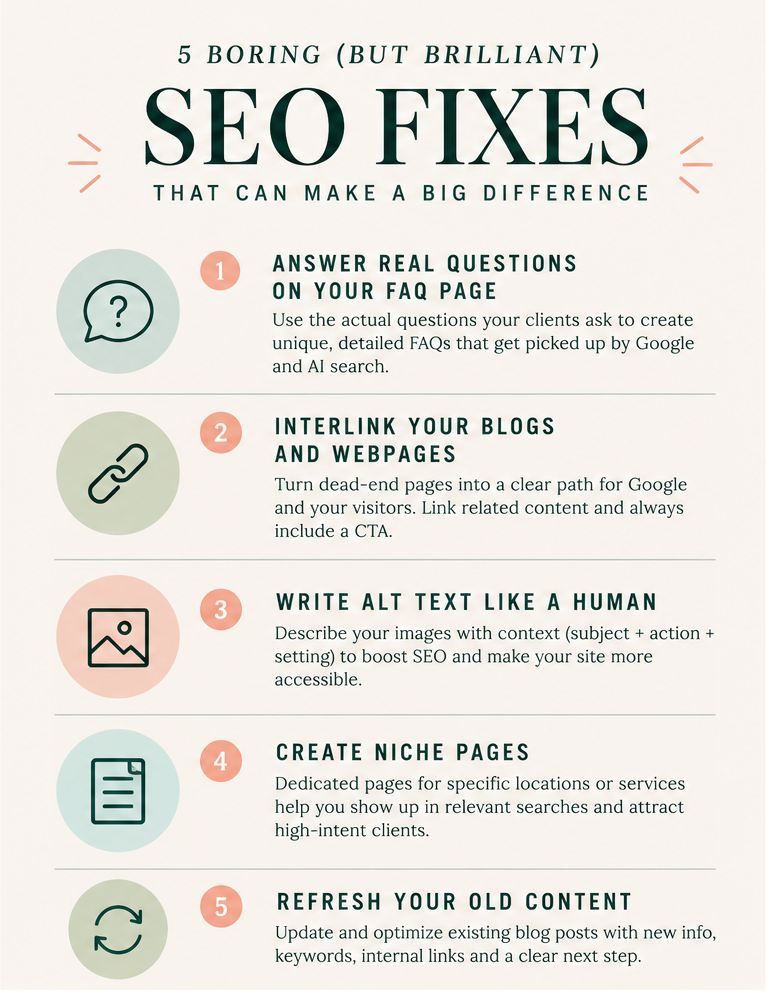
5. Refresh your old posts
New content is key to increasing visibility, but your existing articles are already being crawled by Google and chatbots, making them an easy, immediate win. Make sure they’re still sending the right message with up-to-date information.
How to find your best-performing old posts to prioritise
Look at your website analytics and find which posts continue to get the most traffic. If you have comments switched on, look at your most-commented posts too. These are the ones to focus on first and keep an eye on forever. If a post is time-stamped, e.g. focusing on a specific event that has already passed, then it’s less important – but you can still make sure it contains a link to more relevant content.
How to refresh an old blog post
The best way to refresh an old blog post is to read it and see if it could pass as a post written today. This means checking any statistics, links and examples and updating them if necessary. Make sure your blogs still contain the right information about venues, vendors, prices and anything else that might have changed since you hit publish.
How often should I refresh my blog posts?
This depends on whether they contain time-sensitive information or not. Posts with prices, venues or stats deserve a check every 6-12 months. Evergreen posts can get away with a yearly once-over.
→ Do this today: Find your oldest top-performing post and make sure it still reads as if it were written today.
Small, yawn-inducing changes create outsized results
None of this is exciting – but all of it works. And it gets a lot more fun once you see your brand sitting at the top of Google and AI search.
Type “copywriting guide for photographers” and you’ll see our post from 2023. We still get leads from this article.
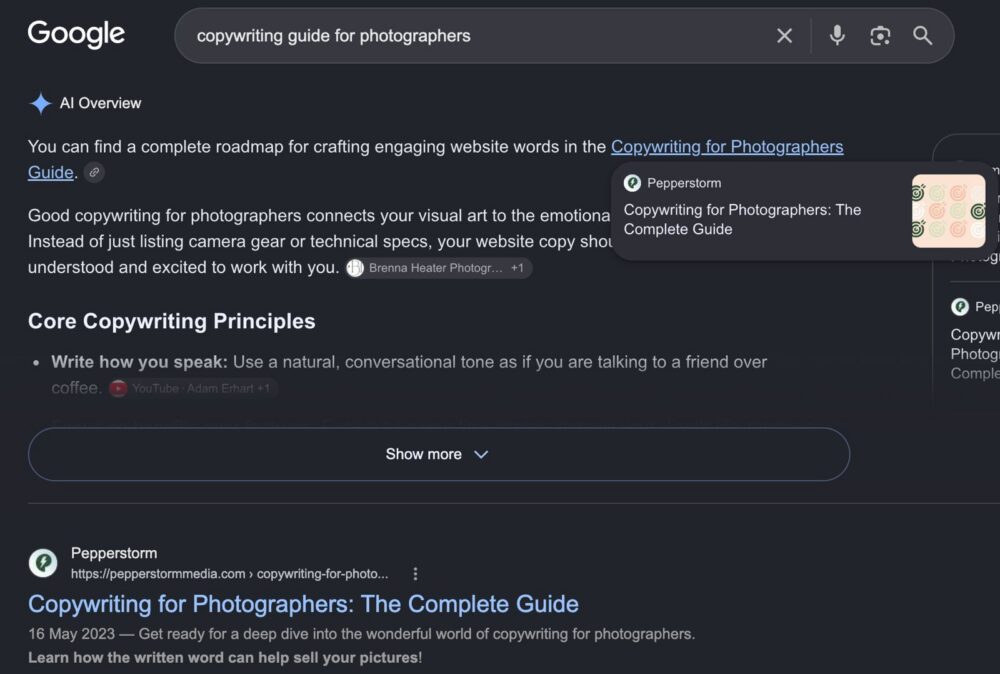
Most people don’t focus on boring. Most people aren’t at the top of Google. I’ll let you connect the dots.
If you’d rather leave the boring stuff to us, then just send a link to your blog in an email or book in for a call, and we’ll do a complete content refresh while you focus on more exciting things in life (of which there are so, so many).