

Have you noticed how personal brands are the new EVERYTHING?
Look at your Insta feed for evidence of this recent trend.
I bet you a whole Bitcoin that it’s clogged full of business owners grappling for attention with their latest hot take that often sounds suspiciously like a lot of other actually-quite-tepid takes.
No shade if you’re one of these business owners. I’m one too.
But whether you’re using your own name or a persona/business name (hey, Pepperstorm), the struggle to get noticed online is real.
In such a crowded landscape, how does a brand stand out?
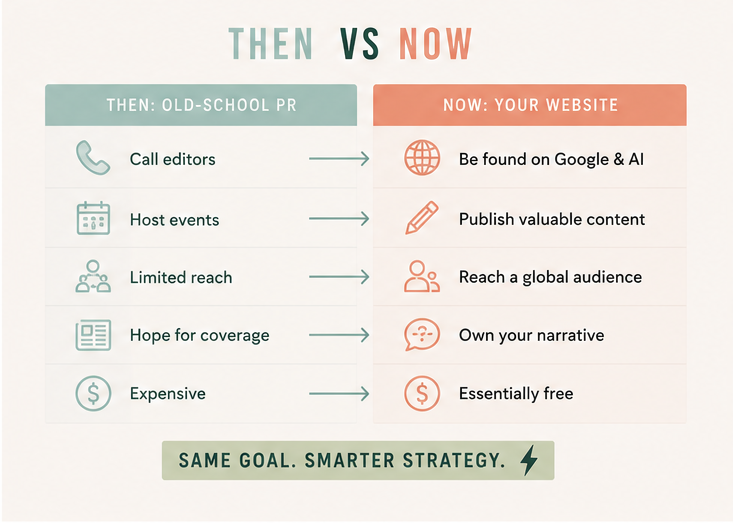
Back in the pre-internet days, you’d hire a PR agent to call magazine editors and host promotional events to create a buzz around your name.
Their job was to control the narrative around your brand story and place you in front of the right people.
And these people still exist – but if you don’t have a lazy $80K to drop on a PR hire, I’ve got good great news for you.
Your website can do most of that job, basically for free.
Here’s how to build your website like a 24/7-hustlin’ PR agent.
Then vs now
If 1990s TV is to be believed, irl PR’s heyday was all Ab Fab energy – a bottle of Bollinger in one hand, giant phone in the other, schmoozing journalists while smearing lipstick off yet another Champagne glass…
Gonna be honest, it looks like Patsy & Eddie had a fun gig.
But then the internet went and happened and the PR game moved from print to search.
Everyone wanted to be found on Google. Less caviar, more keywords.
And now AI has flipped the script once more, as chatbots pull signals from the whole internet (Reddit, YouTube, Insta, reviews, etc.), not just websites. However, a brand’s website is still the biggest signal by far – because you can control every single piece of content that gets published.
Which leads us neatly to why the ‘PR agent’ who’s coordinating all of the mentions, citations, and signals that get your brand ranked on Google and recommended in chatbots is, well, your website.
We’re going to break down each part of this agent’s job and how you can make your website do the hard work for you.
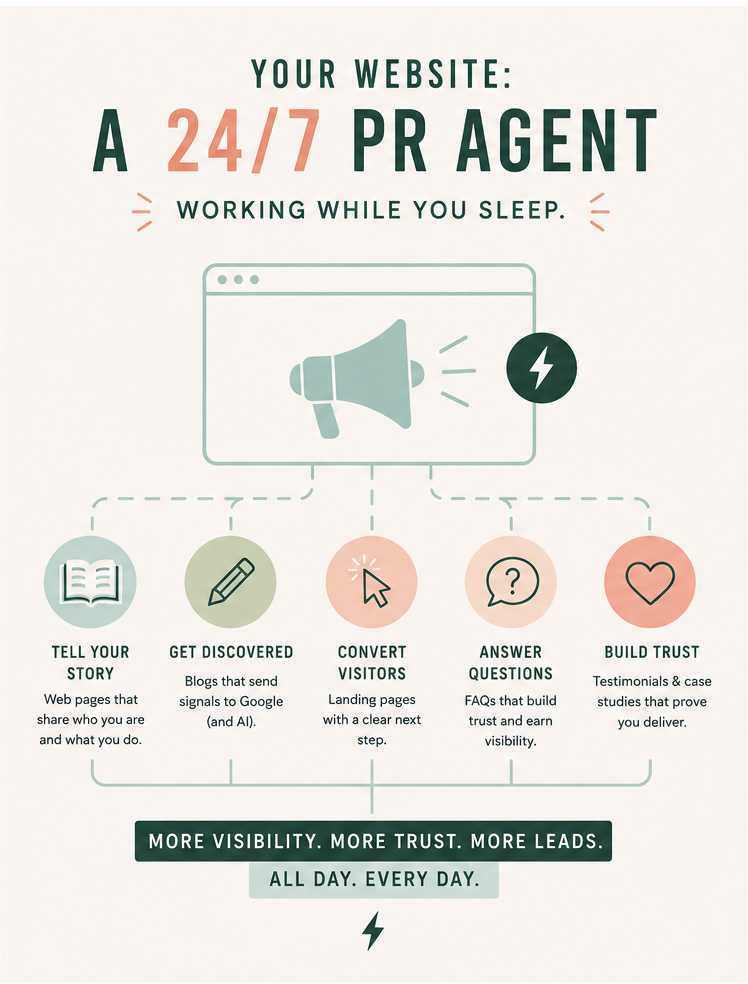
Web Pages = Your Cover Feature
Imagine your brand being the lead story in Vanity Fair / Rolling Stone* – and you get to choose all of the words. Enter, webpages.
* Delete as appropriate – I know which one my inner teenage rockstar would keep.
Your Home and About pages are arguably the most important pieces of content about your brand – because they are the most viewed and referenced pages that tell audiences, Google and chatbots alike what your brand is all about.
This is your PR agent’s core message – the cornerstone content that everything links back to. It’s not a one-off feature – you can update and add to them whenever you like.
But what makes a good cover story? One that flies off the shelves? Originality.
People want to read about unique people/brands doing unique things.
Give your agent an angle to work with by writing authentic copy in a personalised brand voice that sounds like the best version of you.
AI slop gets glazed over by readers and ignored (and sometimes penalised) by Google. Take the time to write from the head and the heart, especially here.
Do this: Read your Home and About page line by line. If a competitor could copy/paste a sentence onto their site, rewrite it to be more you.
Blogs = Press Releases
Now picture a world in which your agent can write straight to publishers every time they want to get noticed for a specific location, specialism or service.
*Big reveal* You’re already living in it, thanks to your blog.
Your blog is probably the most underused, underappreciated and undervalued tool at your disposal.
Not only is every article great content for your audience to consume – they’re little missives sent straight to Google and AI instructing them exactly how to position your brand.
For example, let’s say you’re a wedding photographer in Melbourne. You get most of your bookings from the Collingwood neighbourhood thanks to a bunch of articles all about your favourite venues, relationships with vendors and hidden gem spots.
However, you’ve also started shooting a few weddings in Yarra Valley vineyards and have developed a taste for it (the landscape and the Chardonnay). You don’t need a new website or rebrand to start attracting Yarra Valley couples – just start writing blogs that highlight your local knowledge.
Take a few hours to pen:
- A cornerstone content piece on your guide to Yarra Valley weddings
- A few blogs spotlighting your favourite vineyards
- A travel guide with your personal tips, e.g. the best taxi services for guests and easy routes for designated drivers.
- A packing guide for each season (you could break this into four linked blogs for maximum SEO impact)
Pretty soon you’ll start getting ranked as a go-to photographer in your new favourite location.
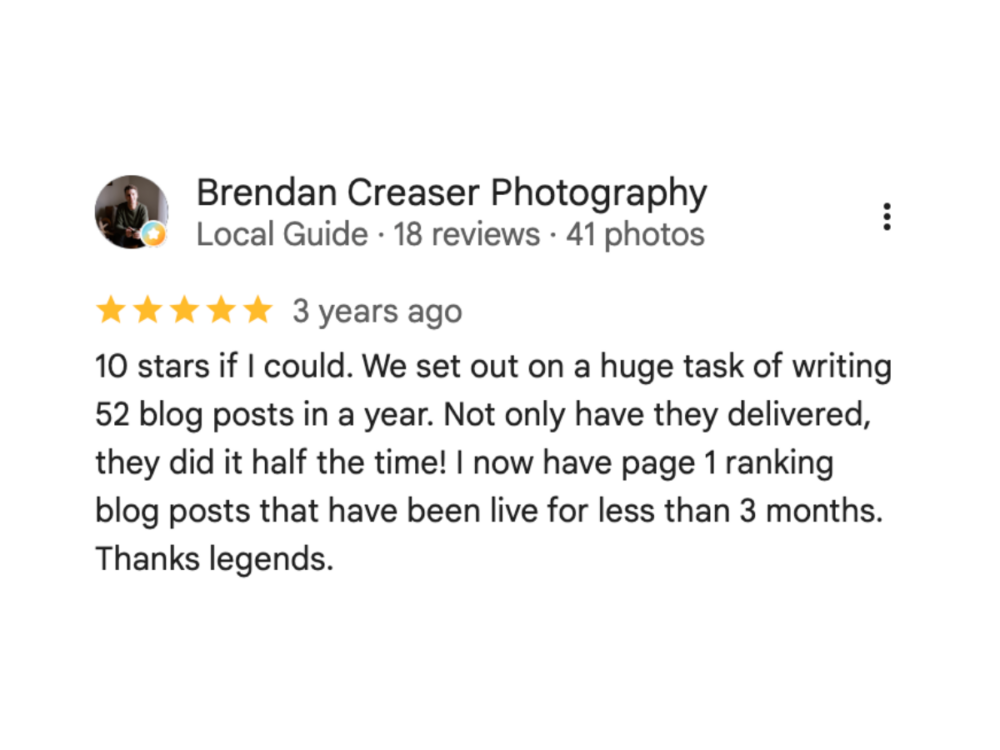
We helped Brendan Creaser Photography dominate the Mornington Peninsula region with an article a week covering every aspect that a couple could possibly want to know.
His website/PR agent was working overtime to deliver so many bookings that he actually stepped away from constant social promotion and moved towards a Google-led strategy. Three years later, he’s still getting passive leads from these blogs.
Do this: Pick a topic that your ideal client is already asking about. Write a piece that leans into your specialist knowledge, structured in a way that’s easy for audiences to read and Google/chatbots to scan and scrape.
Landing Pages = “Get The Look”
Now your agent is moving into a direct-to-consumer role, persuading the audience to invest in your brand.
Landing pages are where the user journey ends and the visitor either pays, gets in touch…or leaves. So they need to be polished to near-perfection as this is where you make those all-important sales.
They’re called ‘landing pages’ as this is where visitors ‘land’ – either from social promotion, a link in an email/DM or an advertising campaign.
However, they can also be the end of a user journey through a well-structured website that has attracted, engaged and convinced them to explore the key offer.
So your Service pages could be seen as landing pages – but so could one-off sales pages or hidden pages promoting a specific product.
Whatever the set-up, a true landing page will not talk to a mass audience but instead speak to one person – the ideal client for whatever it’s selling.
It will focus on one specific service, location or product and all related content (blogs, lead magnets, newsletters, etc.) should link to this page. This should be the end of the journey, with no links other than a call-to-action to buy or get in touch.
Landing pages that have compelling copy and a properly structured flow are hardworking sales agents that can close deals while you sleep.
The great news? You can create a new one for every single service, location or product that you want to promote.
Do this: Pick your most popular service (the one you push the most, the one that pays the bills) and strip it back to one message. Not “here’s everything we do” – just this one single service, with one single button to buy/contact. Then repeat this for every service that you want to offer and watch your conversion rate soar like a muthaf*ckin eagle.
FAQ Page = The Interview
Ooh, the juicy BTS feature. Where your PR agent is plonking you in front of a camera with a prepared script as an interviewer lobs softball questions at you for you to knock out of the park because – you guessed it – once again, you control the copy.
The best FAQ pages are written in a conversational style – the readers are here to get to know you, so write as if your actual clients are asking the questions and answer them in the same tone as you would on a phone call.
And for bonus points, this is exactly how AI tools answer questions – by scraping conversational Q&A content and serving the content up in their answers – making a strong FAQ page a must for AI visibility.
Do this: Look at your last five pre-booking client questions. This is literally how people are searching for you online. Write them as FAQS, exactly how they asked, and exactly how you answered (slightly polished where necessary). Such an easy win.
Testimonials/Case Studies = Endorsements
This is the personal touch. The social proof that convinces an audience that you’re worth their time, attention…and money.
It’s probably your PR agent’s easiest task as the content does most of the selling.
However, there is a way to properly structure and promote the reviews for maximum effect.
A Case Study or Client Journey page is an effective way for future clients to see themselves in your process.
Make sure you choose the type of client that you want to work with in the future in order to attract your ideal audience.
Show their path, including:
- What problem they were looking to solve
- How they found you
- Any hesitations that they had
- What it felt like when they invested
- What it was like to work with you
- The results that they’ve seen
Include eye-catching visuals where appropriate – think graphs, charts and videos of the client talking about your services.
Then share this page EVERYWHERE.
Testimonials can be sprinkled throughout your website wherever you want to add a little oomph to a claim or offer. Just a short, impactful line that says something unique about what you delivered – and make sure you have profile pictures of the clients next to their words if possible.
These endorsements help your PR agent promote a real sense of trust in your brand. Google and AI love this kind of authoritative proof and will reward you in their rankings. Clear case studies and glowing testimonials also help power the leap of faith it takes for a potential buyer to invest.
Check out Brittany Ford’s Client Journey for a good example of how to structure a case study that converts readers into leads.
Do this: Make a list of your best testimonials in as many formats as possible (a written review, a screenshot of a DM, a video, etc.). Pick the three that say something different about working with you, not just repeating,“great service, highly recommend.” Create a case study around your favourite and post the other two on your Home and About page. Then create a social post around each testimonial, linking to your website.
How to make your website a 24/7 PR agent
I hope this highlights how much of an opportunity your website can be for brand promotion and online visibility.
You have an incredible (potentially untapped) resource at your disposal.
And here’s the crazy thing that most business owners don’t quite grasp:
The amount of time/money that you need to invest now is relatively tiny compared with what this agent can deliver for years to come.
Victoria Baker made $100K+ in Google bookings last year. This is about 20x what she spent with us the previous year in setting her Wild Elopement website up with blogs, SEO and landing pages.
Here’s where to start:
- Keyword strategy – Get the right search terms in the right places
- The right words – Real copywriting – no AI-slop, no generic filler
- Landing pages – Speak to one person, not a crowd
- Regular blog content – Consistency talking beats one loud shout for attention
- Fast, error-free website – A healthy agent is a high-functioning agent
And if you want help?
We’ve created hundreds of website PR agents who have gone on to bring in hundreds of thousands in bookings for our clients.
Read our Case Studies. Peek our Reviews.
Then say hi so we can turn your website into Patsy & Eddie a multifunctional PR agent whose sole focus is promoting your brand, 24/7.