
Remember when Uber launched and gave everyone a chauffeur in their pocket? AI is doing the same with personal assistants.
We’ve been able to ask AI to perform tasks on our behalf for a while now. Just the other day, ChatGPT provided an in-depth analysis for my fantasy football team (thank you Mr Altman, your transfer recommendations are gonna win me the league!).
But as we all get more comfortable integrating AI into our daily lives, that interface that used to be a glorified Google search is morphing into a 24/7 lackey who will do a lot of the online jobs you don’t want to do.
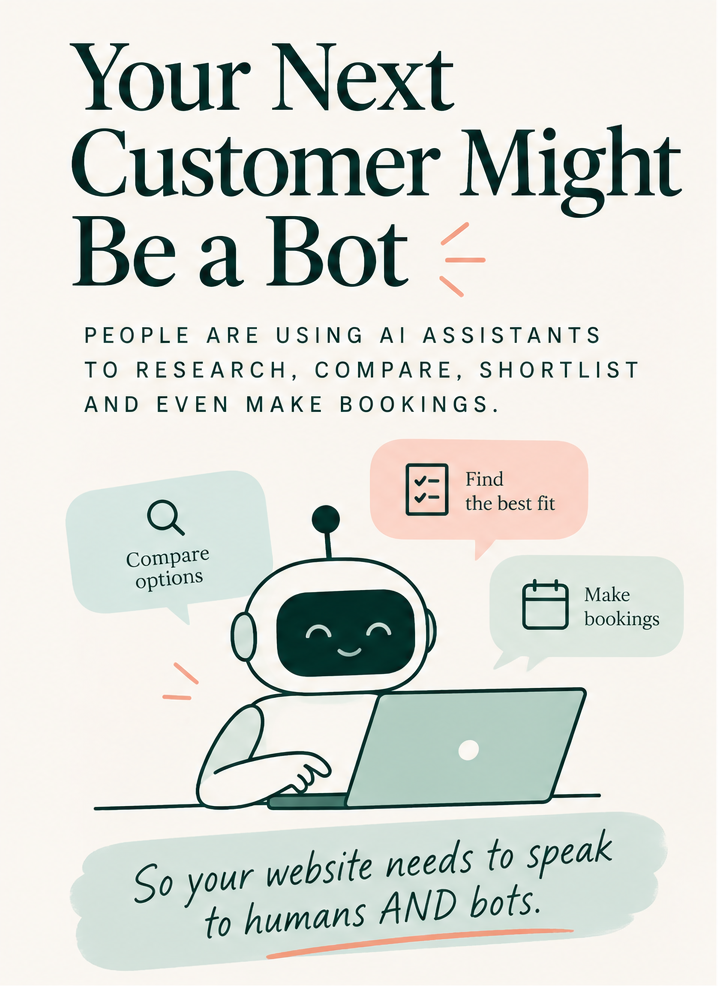
Like online research. You (and your customers) can deploy bots to do the busy work of comparing service providers, identifying which is the best fit and even making bookings and purchases.
So if you’re a small business that sells or advertises online, your website now needs to speak to humans AND bots.
Scary? Not really. Actually quite a MASSIVE opportunity. Let’s dive into how bots are changing SEO and how to maximise this shift for your business.
Pitch to the assistant, sell to the person
It’s not like humans are going to be completely out of the loop. I certainly wouldn’t feel comfortable asking Claude to book a flight, reserve a restaurant table or even buy the right T-shirt without my sign-off. (I’m very particular about my tees.)
But we want the bots to save us time by streamlining and shortlisting. Instead of trawling Google comparing sites, we can ask AI to do that work for us and then present us with a short menu of options.
Kind of like if Google had a Top 3.
How will AI assistants read websites?
Much the same way humans do.
They will look for a clear structure that’s easy to explore and salient information that is presented in a way they can quickly understand.
This means headers, working links and a clear user flow are absolutely vital.
Ultimately, AI will often be linking a human to your website, so it wants to be confident that it’s going to recommend the best experience.
Navigating the site should be a pleasure, not a chore. The content should clearly highlight why your business is the best for the job. And there should be a very easy way to get in touch with you.
If this sounds easy, that’s because it is. But you would be amazed how many people don’t do it.
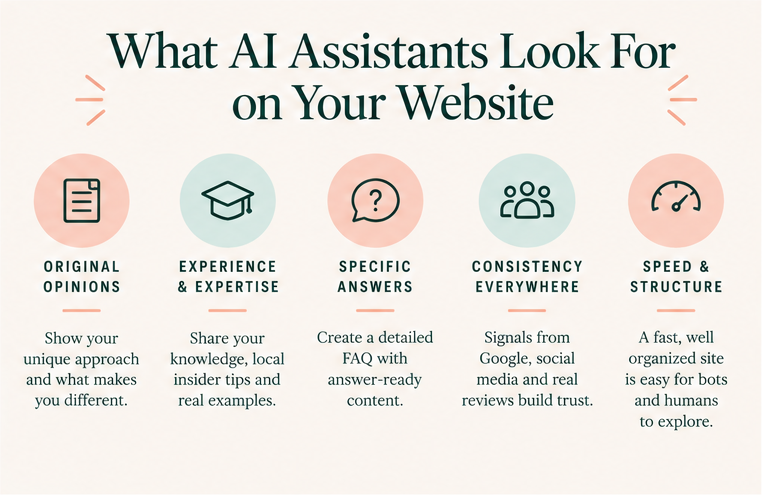
What bots are looking for on your website
AI likes what humans like. And it gets pissed off by the same things.
- A quick, easy-to-navigate site with clear, original information that’s easy to find? AI seal of approval.
- A slow, glitchy site with sparse, copied or AI-generated content? Hard pass, on to the next one.
It wants to give you the best shortlist possible – otherwise your ostensibly time-saving activity can lead you down a rabbit hole of wrong fits.
They want to see:
Original opinions
Write your website pages in a way that highlights your unique approach to whatever service or product you’re offering. Bots are looking for something that reaches out, grabs their attention and screams, “I’M THE ONE WHO’S GOING TO DO THE BEST JOB!”
Experience and expertise
The more blogs and landing pages that spotlight your local knowledge, insider info and hot takes, the better. Remember to link them all up to create a lovely little content hub that a bot can spot and think, “Ah, they get it.”*
*If bots can actually think. That’s a subject for a longer blog.
Specific answers to specific questions
Bots love answer-ready content. Hello FAQ page?! This could be the most important page on your site for AI discoverability – but only if you write it with personality and unique content that is specific to you and your business. Copy and paste at your peril.
Consistency across the internet
The more signals from Reddit, Facebook, Insta and Google that back up your claims to be the best biz for the job, the more likely bots are to believe you.
Speed and structure
Can a bot jump onto your site and understand what you do immediately? Can it follow links to find out more information to back up your claims? Does each page load quicker than it takes them to think, “Hmm, there might be a better site around the corner…”? Yes, yes and yes? Congrats.
AI learns your tastes
The more we all use AI assistants, the more they’ll learn our tastes.
So although you’ll always need to give specific instructions on dates, timelines, budgets, etc., over time your chatbot will figure out what type of stuff you like and will organise its recommendations accordingly.
This is great news for small businesses that focus on SEO, as they can tailor their content towards their ideal type of client. Match your tastes with theirs, reflect this in your content, and your website starts attracting exactly who you want to work with.
A scene in a website
Let’s say I need to find a photographer and I don’t want to spend time doing a traditional search, punching keywords into Google.
So I deploy my assistant: “Hey Claude, find me a photographer who will shoot a family session in Portland, Oregon, next month. I want them to be good with babies, have at least a few years’ experience and tell me why they’re special. My budget is $500 to $1,000 and I want the prints within a week.”
Claude scrapes the internet and looks for signals that a website contains the type of information I want.
A website that has:
- original copy, written from the head and the heart
- a long FAQ page that answers all of the questions I might want to know
- a specific landing page saying that they specialise in this exact niche
- keywords like “Portland, Oregon”, “photographer” and “family photographer” in the right places on their website
- case studies and testimonials from real customers
is going to make the shortlist above anyone who:
- doesn’t have a website (yikes!)
- offers sparse, unclear or outdated information
- has not optimised their site to be found by these specific searches
Honestly, most photographers are in the latter category. Which is great news for those in the former, as it makes it way easier to stand out.

Why bots don’t like bot content
“You can please some of the people all of the time, all of the people some of the time, but you can’t please all of the people all of the time.” Variations of this sentiment have been said by Abraham Lincoln, 15th-century poet John Lydgate and Bob Marley.
Sorry, lads – ChatGPT didn’t get that memo.
AI content regresses to the mean – it tries to please everyone and, as a result, often comes across as bland, boring and sycophantic.
This type of content can be fine for skimming information – glossaries, technical specifications, recipes, etc. However, if you’re a brand that wants to stand out amongst competitors, you need to offer AI something that it can’t just create itself.
That’s why bots like non-bot content. Just like humans, they prioritise original, useful information and clear examples of proven wins.
If a chatbot scans your site and sees purely AI-written content, it will identify a lazy human who doesn’t deserve to be on its shortlist. Harsh, but that’s the way it is.
Google even launched an update in September saying that a human should fact-check and edit AI content before it goes live, meaning it can penalise sites that have purely AI-generated content. Source: Google
“Google does not automatically penalize content just because AI was used. However, it cracks down on content that lacks human oversight, originality, factual accuracy, or real user value.” Source: Code With Amendra

So should you stop using AI?
Nope! AI is an incredible tool in copywriting and SEO. Research, structure, proofreading – even brainstorming.
But the thinking, the stories and – above all else – the voice have to be yours.
You can tell when someone’s used AI. And if you can, your customers can. And chatbots definitely can.
Just like your customers are using AI as an assistant, you too can use it as a writing and research assistant – not an author.
How to write your website for bots (and humans)
Be human. This above all else. Identify your brand voice and then write all of your content in this style, showing the type of consistency that earns reputational authority.
Show your specific expertise. Dedicated pages and articles that highlight your experience, local knowledge and insider tips.
Make sure your site runs quickly and smoothly and is easy to use.
For better or worse, bots are a lot like humans: they like quality content, published regularly.
I write these monthly blogs knowing that you (a human) and you (a bot – hey, Claudette!) will be reading them.
But they’re always designed to inform and engage you – my ideal audience.
Get your site ready for the bots
Would you like a website that engages humans AND bots, promoting your brand while you sleep? You would?!
Well, I’ve got good news for you… That’s exactly what we do.
Peek our Case Studies to see how we transform clients’ websites into the hardest working part of their business.
Then send a message or book a free call. Let’s turn the bot invasion into a win for the humans (well, one human in particular… you).