
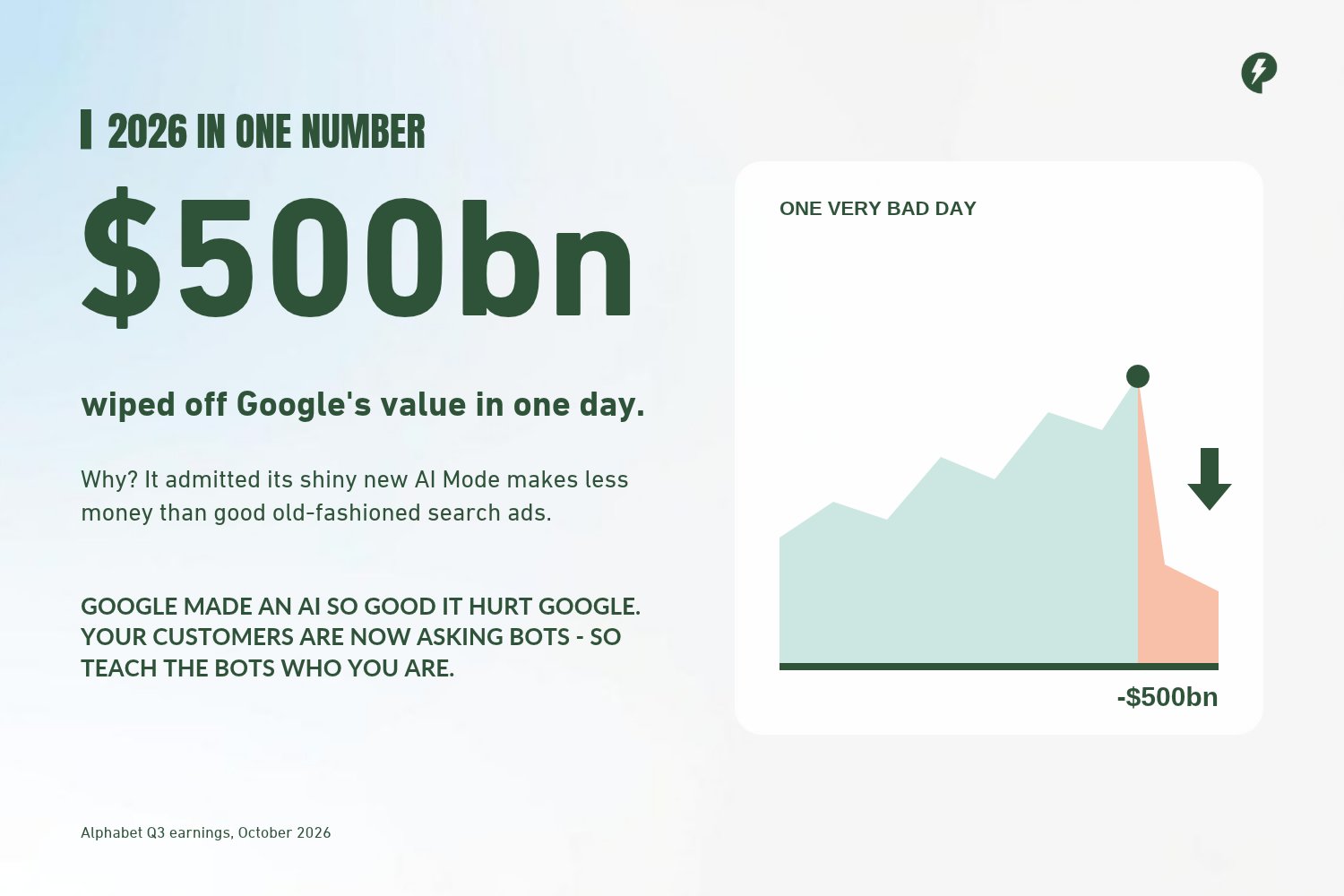
Well, it’s been quite a year. My favourite bit? Google made an AI so good that it hurt Google. In October, Alphabet had its biggest market value wipeout on record – roughly $500 billion gone in a day – after admitting its shiny new AI Mode makes less money than good old-fashioned search ads.
Translation: your customers are now getting their answers from an AI bot that’s already read your website and decided whether you’re worth mentioning.
Which means bot traffic has gone from “ugh, spam” to “yes please” – as long as it’s the right kind of bots.
So let’s look ahead and work out how to get your website SEO-ready for 2027.
📝 Psst. Is your website ready for 2027? Grab the free 2027 SEO Scorecard at the bottom.
But first, a quick question…
When did SEO get so sexy?
Have you seen the AI headlines lately? It’s less tech news, more daytime soap.
Nvidia CEO Jensen Huang admitted to an affair with a woman US officials allege is a Chinese intelligence asset. (China calls it a smear. Nvidia’s share price called it a 5% drop.)
OpenAI’s Sam Altman is being played by British-American heartthrob Andrew Garfield in Artificial, out in US cinemas on Christmas Day. Nothing says festive fun like a boardroom coup.
And Elon Musk – whose SpaceX swallowed his AI company xAI this year so it can build data centres in space – is reportedly offering women money to have his babies and keep quiet about it. He calls it a “legion”. I call it “more than a bit creepy”.
But behind all the horny shenanigans, the most important AI story for small businesses was a pedestrian one. Google’s own team said it out loud: optimising for AI search is still just SEO. Their May 2026 guide says AI Overviews and AI Mode run on the same ranking and quality systems as regular search.
Forget the shiny AI hacks – the boring stuff still works, so stick with the tried and tested ‘quality content, posted regularly’ approach.
The Pepperstorm team feels particularly happy about this, given that we wrote a whole Boring SEO Checklist a few months ago.
What changed in 2026
It’s been the year of the bot. AI assistants are changing SEO and this is particularly important to small businesses whose customers find them online…so yeah, like 99% of small businesses.
Google started answering its own questions
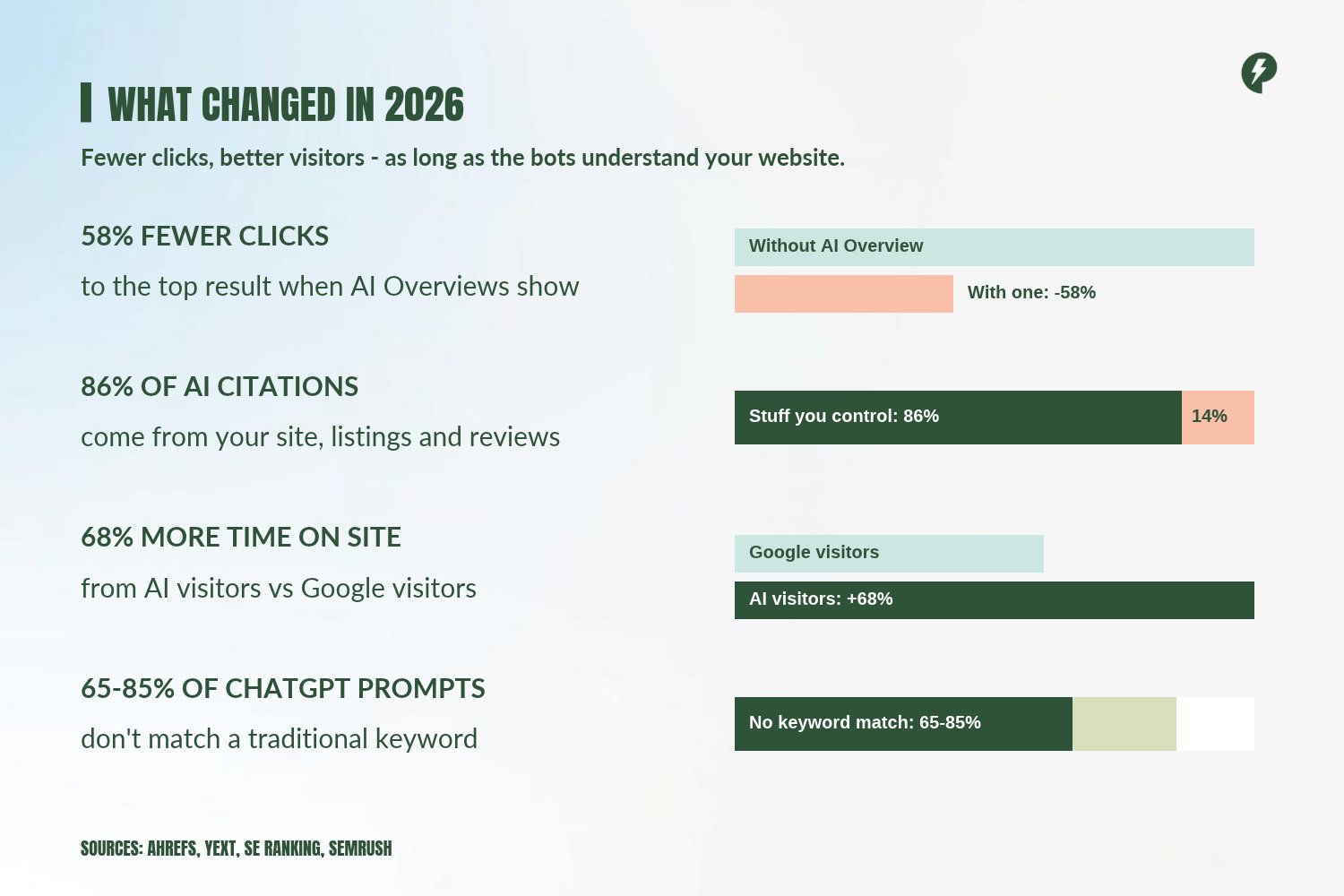
AI Overviews now sit on top of a huge chunk of searches, gobbling up clicks. Ahrefs found that when one appears, the top-ranking page gets 58% fewer clicks.
How-to blogs get fewer clicks – but they’re doing a different job
They’re teaching Google (and ChatGPT, and Gemini) who you are and what you know, which is how your brand ends up being the one the AI quotes and recommends.
* Shoutout to the early SEO adopters here. Those how-to blogs you published back in 2019? They’re the reason Google considers you an expert today.
Recommendations became a shortlist
Ask ChatGPT for a good accountant in Leeds and you won’t get Google’s classic ten blue links – you’ll get three names. The trick is to be one of them.
And because people ask for things in a million weird and wonderful ways (“accountant who doesn’t make me feel stupid about my receipts”), there are a million different shortlists to be on.
Your website matters more, not less
Remember the 2022 panic that AI would replace websites? The opposite happened. When BrightLocal studied ChatGPT’s local search, 58% of its sources were business websites.
A bigger Yext study of 6.8 million AI citations found that 86% came from sources businesses already control – their websites, listings and reviews.
Far from replacing your website, AI is reading it and then deciding whether to recommend you.
AI visitors = quality visitors
AI still sends far less traffic than Google, but the people it does send stick around – they spend 68% more time on websites than visitors from regular search.
This means fewer clicks from the right kind of people – or their bots.
Bing is the dark horse
ChatGPT leans heavily on Bing’s index when it searches the web, and Bing Places listings feed into that.
So you can have a perfect Google Business Profile and still be invisible to ChatGPT. You and I don’t use Bing – but ChatGPT does.
Key takeaway: Google’s clicks are shrinking but the bots are reading more than ever. So SEO in 2027 isn’t about working out how to get more traffic – it’s about teaching the machines exactly who you are, so they put you on their shortlist.
SEO advice: What to STOP doing in 2027
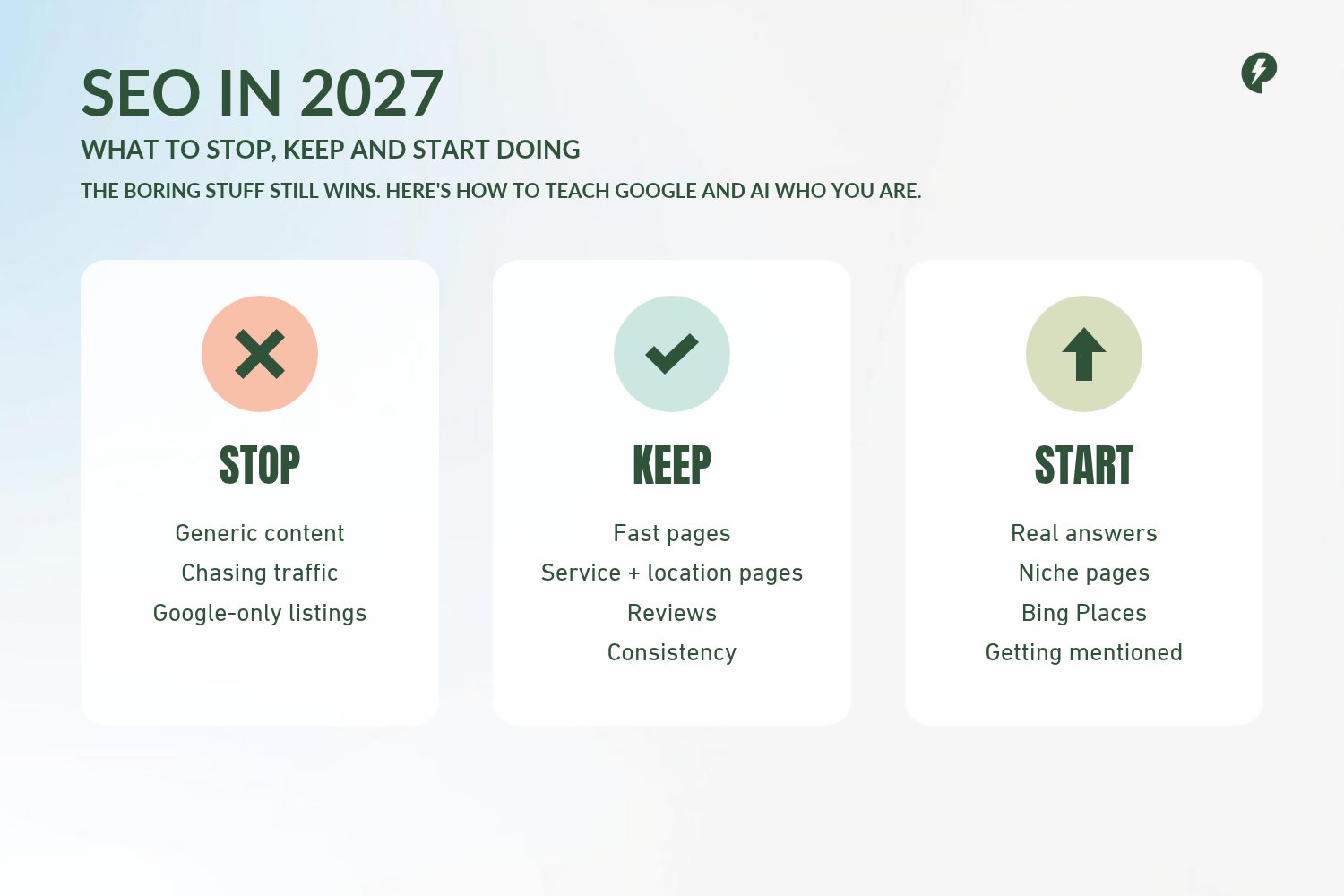
Stop publishing anything generic
AI made generic content free. Anyone can churn out “10 tips for choosing a dentist” in four seconds.
Which means the stuff AI can’t fake – your opinions, your stories, your actual experience – just got a lot more valuable.
Create content that a chatbot couldn’t write – the chatbots will love you for it.
Stop obsessing over traffic
Traffic is going down for almost everyone, and that’s OK. We measure success by enquiries, which come from having the right kind of visitors sent by Google and AI search.
Stop relying only on your Google Business Profile
Google is still the big one, but it’s not the only map in town. Bing, baby. (More on that below.)
SEO advice: What to KEEP doing in 2027
As promised, the boring stuff still wins.
Keep your site fast
Slow sites lose people and rankings faster than you can say “is this on dial-up?” Huge image and video files are often the culprit – fix these, pronto.
Keep building location and service pages
Your website should have one page per service and one page per area.
If you’re a physiotherapist who also does sports massage, those are two separate pages.
If you serve Bristol and London, those are also separate pages – not one paragraph on your homepage.
Create pages that talk to your ideal customers and that’s who Google & AI will send your way.
Keep it specific
AI can only recommend you for services, products and locations that you’ve specifically told it about – use landing pages and blogs to say exactly what you do, who for and where.
Keep collecting reviews
Reviews have always been important – but now they’re frickin’ crucial.
Not only do Google and Facebook reviews impress potential clients, AI tools check them to decide who’s trustworthy.
Keep earning links & mentions
Every backlink to your site – from local press, partners, suppliers, podcasts, directories, other businesses you work with – is a vote of confidence that bots can see.
The really interesting development in AI search is that bots can also understand your brand name without the backlink – so if a Reddit user just types your name in a positive recommendation, AI can pick that up too.
Keep everything consistent
Make sure you have the same business name, address and phone number everywhere.
If your website says “Smith & Co” and your Bing listing says “Smith and Company Ltd”, the bots get confused.
This also goes for your brand voice – if your website contains elegant, luxury-style copy but your Insta is full of F-bombs, this inconsistency is particularly jarring for your audience and bots alike.
That’s why I drop F-bombs everywhere, just to be safe.
SEO advice: What to START doing in 2027
Start answering actual questions
Your FAQ page shouldn’t be built around what you think customers want to know – what they actually ask.
Dig through your enquiry emails, DMs and discovery calls. Every question you’ve answered more than twice deserves its own page or blog.
People ask AI long, chatty questions, and between 65% and 85% of ChatGPT prompts don’t match any traditional keyword. The only way to cover those is to answer real questions in plain English.
Start building niche pages
Landing pages are how you become king of a very specific castle.
“Find me a Manchester accountant” is a crowded shortlist. “Find me an accountant in Didsbury who specialises in helping freelance designers with tax returns” is a much smaller one.
Aim small, miss small.
Start listing yourself everywhere AI looks
You should have your Google Business Profile set up by now – but I bet your Bing Places is yet to be touched? Amirite?
Hot tip: you can import your Google profile in a few minutes.
Same goes for Apple Business Connect, Yelp, and other directories that matter in your industry.
Start getting mentioned everywhere
AI reads everything: podcasts, LinkedIn, Reddit, Instagram, local news, industry blogs… if it’s online and it’s got text, there’s a good chance that it’s on AI’s radar. So you need to be everywhere too.
The best way to do this without risking content creation burnout is to make content you can repurpose. One good blog can become a newsletter, three social posts and a podcast talking point (just wait for the newsletter and carousels taken from this piece).
Start talking to AI
Go straight to the horse’s mouth. Ask your favourite chatbot, “Who’s the best [YOUR SERVICE] in [YOUR LOCATION]?”
See who it recommends. Look at what they’re doing. Then do it better.
Is your website SEO-ready for 2027?
Does it sound like you’re doing everything you need to in order to set your site up for SEO in 2027?
Yes? Tasty. Go order some mince pies for Dec 25th. No? Don’t worry. Grab the free 2027 SEO Scorecard – 10 yes/no checks, 5 minutes, and you’ll know exactly where you stand.
We’re also opening up a few spots for our 2027 SEO Package in December – launching December 1st. We’ll get your website ready for Google (and all the best bots) before the new year kicks off.
To see what can be achieved with SEO and copywriting, peek our Case Studies page to follow our client journeys – from solopreneurs and startups who needed to get found with SEO to a billion-dollar brand rewrite.
Any questions: Book a chat or send us a message. Let’s make your website do the hard work in 2027.