


AI may offer short, snackable answers as its default serving – but it loves to feast on longform content.
So when you’re writing about why your brand should be featured in AI search – think multi-course tasting menu over a quick cheese sandwich.
Why should I want to be featured in AI search?
AI answers are the new Google search listing. Every brand wants to be featured in a ChatGPT response to a client’s question!
Being spotlighted when your ideal client asks a question about your brand builds trust, authority and increases the likelihood of them getting in touch or making a purchase. Win, win, win.
But AI search isn’t going to feature you just because you think it should. You need to teach AI why you deserve the spot.
This means that you now have two audiences when writing content: your customers (past, existing and potential) and AI.
The more quality content that you write about your specialist subjects, the more likely you are to feature in AI answers.
That means it’s time to go deep.
I don’t want to overload my website with loads of copy
Most brands want their website copy to be sharp, concise and impactful. And they are 100% right to do so.
Your homepage should convey your brand name, message, tone and core offering within 3 seconds. That means punchy, impactful sentences – not long paragraphs of deep insights.
So where do we place this crucial longform content? Your blog.
Your blog is the unsung hero of your website
Wait, is blogging really relevant for brands in 2026?
1000%.
Blogging has always been the subtle engine that drives a brand’s online visibility. And AI has only made it more important.
That’s because your blog allows you to:
- Break down topics in a way AI can actually understand and trust
- Show real experience and expertise
- Share examples, case studies, results & testimonials
- Unpack subjects from your own perspective
And all of that feeds into how AI understands your brand.
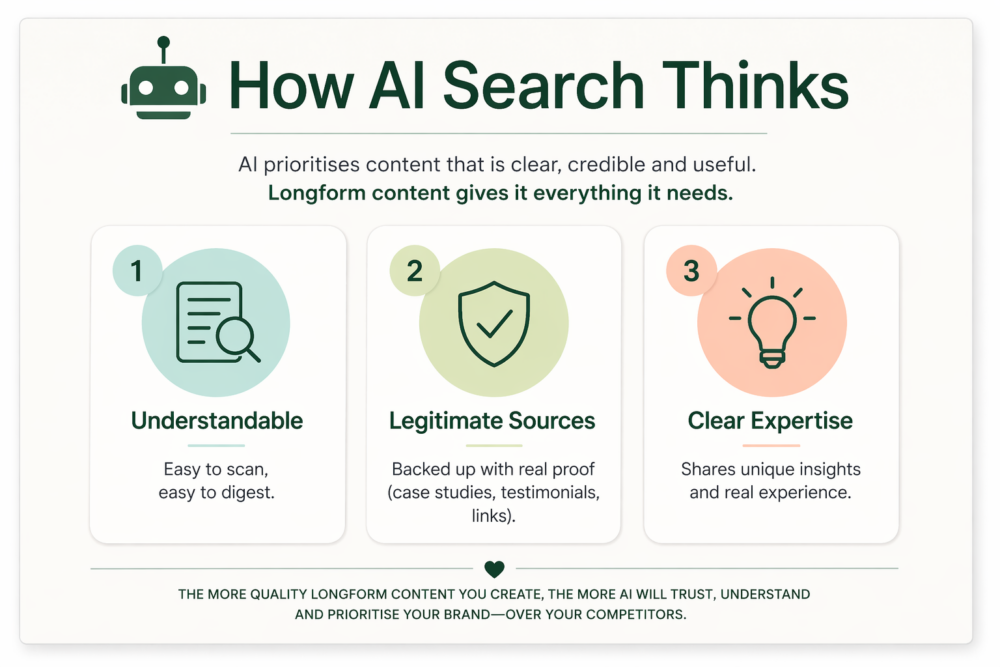
When AI tools scrape content, they look for sources that are:
- Clear and easy to understand
- Backed up with real proof (case studies, testimonials, links)
- Consistent in what they talk about
Longform content makes it easy for AI to prioritise your website above competitors.
Imagine a world in which AI search doesn’t exist (think back just a few years!). Your friend has asked you to find a photographer for their wedding in Cannes, France.
You find three that look great, with perfect photos in the exact style that your friend wants. But only one of them has a blog explaining their favourite areas of Cannes, France: the ideal spot for golden hour, the most reliable and affordable taxi firm, and a variety of quality restaurants.
Deciding who to pick becomes a no-brainer.
The best thing? There’s no limit to the amount of longform content you can post on your blog, as long as it’s relevant to your goals.
Choose multiple locations, different areas of your business that you want to spotlight and create mini content engines around them in the form of blogs, downloadable PDFs and landing pages.
By offering more reasons for AI to feature you, your ‘lead gen’ net is cast much further. Just make sure that you are confident in what you’re writing about and that the content supports your business goals and ultimately speaks to the type of clients you want to work with.
How to make longform content work for your brand
1. The right structure leads to more visibility
Just because it’s a long article, don’t just brain dump.
Lay out your thoughts in a format that’s easy to digest by using clear sections and headings.
Make it easy to scan and your readers (and AI search) will thank you for it.
2. Talk about your experience
This is what’s going to set you apart from AI content.
Human experience is the one thing that AI can’t have – and this is why it values it so highly.
Google added Experience to its list of ranking factors (Experience, Expertise, Authority & Trust) around the time that ChatGPT dropped. Coincidence? I think not.
Adding perspective that comes from human experience will help your content get found and promoted over blogs that could be (or actually are) just written by AI.
3. Don’t try to cover everything in one post
If you find yourself drifting into a new angle (and it’s an interesting one), start a new blog! Then link them together.
This helps both readers and AI understand what each piece is actually about as well as boosting page views and time on site (which signals your authority to Google & AI search).
4. Link everything
Don’t let your blog articles become lonely – connect them with related content.
Link to:
- Case studies
- Galleries
- Other blogs
Anything that reinforces what you’re saying, even if it’s on another website (just not a direct competitor’s).
This builds a stronger signal around your expertise while creating a helpful journey, as opposed to a dead end once the reader has finished reading.
You can send your blog to whoever you’ve linked to and increase the chance of them sharing it with their audience.
5. Add a Table of Contents
This is a simple yet overlooked element that can be a quiet gamechanger because it helps readers and AI search quickly understand the structure of your article and navigate to the relevant bits.
Again, compare this with a competitor who hasn’t taken the time to put this on their blog – you’re gonna be prioritised.
6. Build a central hub
This is the bit most people miss and it’s the one that you really should focus on, especially if you focus on a specific niche, area, etc.
If you want to be known for something specific (e.g. a target location):
- Core page: Create one landing page that focuses solely on that topic.
- Supporting blogs: Write regular articles about your experience and expertise on this subject.
- Internal linking: Link all relevant blogs (new and existing) to this page.
Now all of the content you write adds to this system that’s constantly working to build visibility in the areas where you want to be seen.
By the time someone lands on your core page, they’ve already seen your thinking, your work, your perspective, your experience.
They’re now way more primed to take action as opposed to just clicking through from an ad.
This type of trust can’t be hacked – which makes it the most valuable.
7. Be un-ignorably original
Taking inspiration from peers who you admire is a great way to start your content journey. Just don’t copy them too closely.
If you don’t add your own angle, not only will you risk being seen as a rip-off merchant, but AI search will just see you as a less confident version of your competitor and will rank them over you every time.
This is the same as asking AI to write your blog for you, without putting any of your own originality into it. AI search will recognise that it’s unoriginal and simply deprioritise you, and Google may even penalise you for unhelpful content.
Instead, be creative, be weird, be unique – because this is what people are interested in. And if people are interested in your content, this signals that AI search should prioritise it over others.
Create a body of work
Long-form content strategy only works if you’re consistent. One blog ain’t gonna do it.
When you write a post, it sits in a growing body of work that positions your brand as the go-to authority on your target topic(s).
Over time, that’s what makes it clear to your audience and AI search: “This is what this brand is known for.”
Then your marketing becomes obvious, your leads become passive (as in they come to you, no chasing) and any piece of content you make strengthens this position.
The mindset fix
Ask yourself: “Why should AI choose me over someone else?” “What am I showing that they aren’t?”
If you want to be featured in AI search when people search for a specific topic, you have to actually talk about it.
The best way is by writing in depth content that displays relevant experience and unique knowledge – repeatedly.
“But I have a life! And so many other elements of my business to focus on!”
That’s fair. So do most business owners. If you’d rather leave this task to friendly experts…
Let us cross it off your to-do list.
Check out our blogging services and then say hi so we can tailor a package that grows your business while freeing up your time.