
De La Soul nailed it back in ’89 – ‘three’ really is the magic number.
In the hip-hop trio’s case, this mystical digit was a celebration of unity and friendship and, uh, D.A.I.S.Y. philosophy…
But in your case – as a small business owner – it’s the number of pages your website needs in order to start working for you while you sleep.
Stop me when this sounds familiar…
Most small business websites struggle to generate enquiries. Not because the business is bad, or their service isn’t valuable.
Usually, it’s because visitors land on the website and don’t understand what the business actually does fast enough.
When someone arrives on your site, you have seconds to answer three key questions:
- What do you do?
- Who is it for?
- What should I do next?
If those answers aren’t obvious, people shuffle quickly away to search for a competitor.
While a website can include many pages – Blogs, About, Resources, FAQs, Gallery – most of the heavy lifting is done by just three core pages.
When these three pages are structured, written and SEO-d properly, they guide visitors from curiosity to trust to enquiry.
Let’s break them down.
1. The Homepage: Your Website’s Mothership
Your homepage is usually the first place people land.
It’s your first impression and your central hub, so it needs to communicate your value quickly and clearly.
A strong homepage should answer three questions immediately:
- Who is this for?
- What does this business do?
- Why should I care?
If someone lands on your site and can’t answer those questions within a few seconds, the likelihood of them sticking around is close to zero.
Remember the old copywriting motto: If you confuse, you’ll lose.
Think of your homepage as the mothership of your website – every other page supports it.
The homepage is where your journey begins – visitors can choose their own adventure by exploring the other pages that are built to support it.
Effective homepages usually include:
- A clear headline that explains the core offer
- A short explanation of who the service is for
- Quick navigation to your services
- Proof elements such as testimonials or results
- A clear next step (contact, enquiry, booking, etc.)
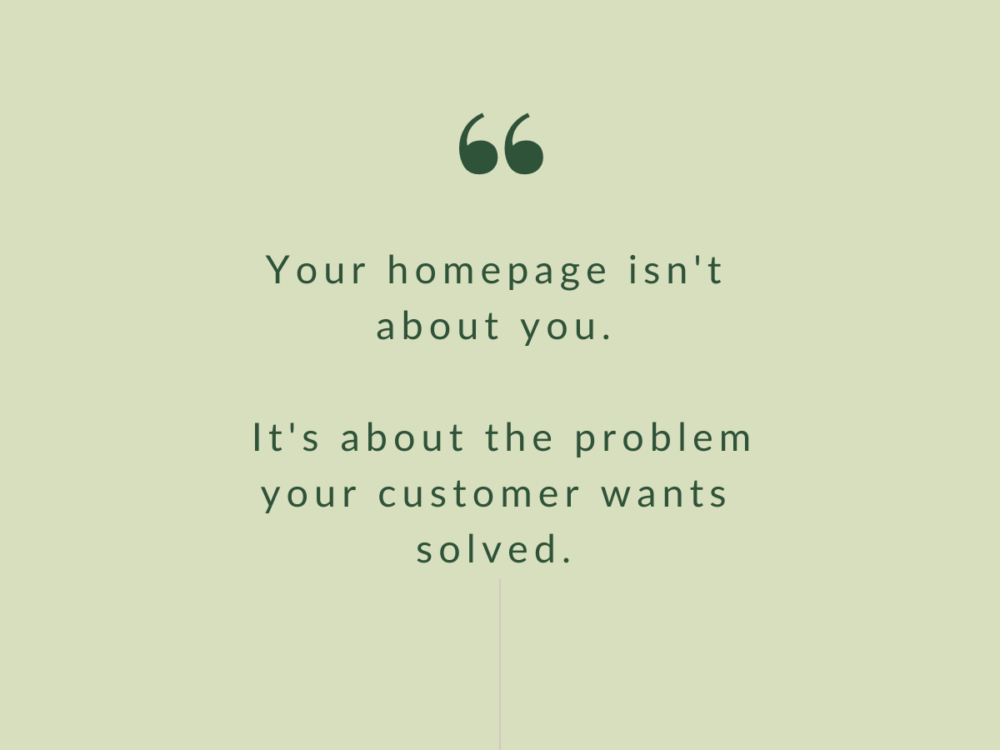
Many businesses fall into the trap of making their homepage about themselves…
They’ll write about their journey, the passion that led them to creating the brand, or simply list why they are so damn good at their job.
All of the above may be true and relevant to mention at some point on the website – but the most effective homepages focus on the customer’s problem and the outcome they want.
If visitors see themselves in your message, they’re far more likely to keep exploring.
The 5-Second Test
Look at your homepage and ask someone unfamiliar with your business: “Can you tell what we do within five seconds?”
If the answer is no, your message likely needs simplifying.
(Psst. Look at our homepage. Does it pass the test?)
2. The Services Page: Where You Explain How You Help
OK, your visitor now understands what you do. They’re interested enough in your offering to start exploring.
The next question they ask is: “How exactly can you help me?”
It’s time for your services page to step up to the plate.
This page should clearly explain:
- What you offer
- The problems you solve
- The outcomes your clients experience
A common mistake is listing services as vague bullet points like:
- Marketing
- Consulting
- Photography
That doesn’t mean much to a visitor.
Instead, frame services around the transformation your clients want.
For example:
Instead of: “Photography”
Try writing your main service, style and target location: “Cinematic wedding photography in Sydney”
This directs the brand message to a preferred niche who will actually be interested in your services.
Your services page should also make it easy for someone to take the next step.
That might be:
- Booking a discovery call
- Filling out a contact form
- Starting a checkout process
- Downloading a free resource
- Requesting a quote
If someone is interested but can’t easily figure out what to do next, you lose momentum.
Clear pathways convert curiosity into action.
Test:
Review your services page and ask: Does this clearly explain the problem we solve and the outcome clients can actually expect?
And could someone who is not tech literate easily work out how to contract me?
If it only lists services without context, it needs a lot of improvement.
Peek our Services page – see how we have a clear tagline underneath each individual service?
Then when you click through to the actual service, e.g. SEO Supercharge, it offers a clear (jargon-light) explanation of exactly what the service entails and how it will help your business.
3. The Results Page: Where Trust Is Built
If the proof is in the pudding, your results page should be a groaning dessert trolley.
In 2026, people rarely buy based on claims alone. They want evidence.
Your results page is where you demonstrate that your service actually works.
This page can include:
- Client testimonials
- Case studies
- Before-and-after examples
- Data and performance metrics
- Photos or videos of real clients
- Screenshots or project outcomes
The goal is simple: help visitors see themselves in the success stories you share.
Someone visiting your website is usually dealing with a problem.
They want reassurance that:
- You’ve helped people like them before
- Your process works
- They can trust you
Case studies are especially powerful because they show the full journey:
- The problem the client faced
- The solution you delivered
- The results achieved
You want a visitor to easily visualise their own journey through your work.
This leads to subconscious trust…which leads to a conscious decision to make an enquiry.
Test:
Review your website. Does it have a page dedicated to:
- Client journeys that go from “I have a problem” to “This business solved it”?
- Random testimonials from previous clients?
- Nothing at all?
If it’s b) or c), it’s time to start showing off your wins.
Reviews are good. Case studies are persuasive.
If your website only says you’re good but doesn’t show it, start collecting proof.
Start with a few strong testimonials and build from there.
Check out our Case Studies page – we’re writing new client journeys every month…
And backing them up with dozens of success stories on our Reviews page.
Remember what Muhammed Ali said: “It ain’t bragging if you back it up.”
Why These Three Pages Matter
I’m not saying that your website only needs these three pages – but they should be the ones you focus on first.
Don’t clutter your website with too many unnecessary pages that don’t clearly guide visitors…
Instead build the magical three that work in unison to create a powerful client journey from “hello” to “I’m interested, tell me more.”
TL;DR
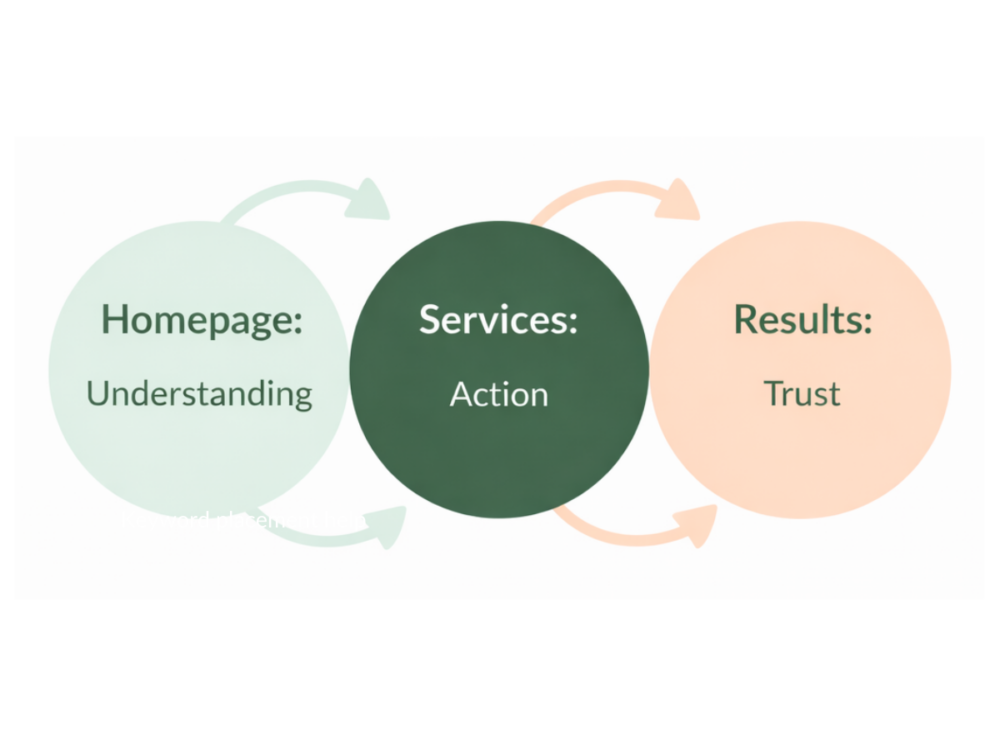
Homepage: Introduces your business and captures attention.
Services Page: Explains how you solve the visitor’s problem.
Results Page: Provides proof that your solution works.
This combination moves visitors through the key stages of decision making:
Understanding → Trust → Action
The framework itself is simple.
The challenge is building pages that communicate clearly, guide visitors, and convert attention into enquiries.
Don’t overcomplicate it…
Just make it effective.
In many cases, improving just three pages can dramatically increase how many visitors turn into leads.
If your website isn’t generating enquiries, it’s often not a traffic problem – it’s a clarity and structure problem.
Simply put:
Fix the messaging.
Strengthen the proof.
Make the next step obvious.
And your website starts working much harder for your business.
If you’d like help building or improving a website that actually converts visitors into leads, say hi today.