
Maybe it’s because I am immersed in the search industry every day but it feels as if every business owner is starting to ask, “how do I get found on AI search?” “Is AEO replacing SEO?” “What the hell is AEO?! I was just getting my head around SEO!!”
Honestly, most small business owners don’t need to start learning a bunch of new jargon to understand how to get found on ChatGPT. It’s very similar to how to get found on Google. With a few key differences.
That’s why I’ve written a Beginner’s Guide to AI Visibility – a step by step process to help your brand get found on ChatGPT, Gemini, Perplexity & Claude…and maybe even Grok.
Who Is This Blog For?
You’re a solopreneur or small business owner who wants to make sure your website doesn’t get left behind in the shift to AI search. Welcome!
What Is AI Visibility?
Put simply, AI visibility is when your brand shows up in chatbot answers when an audience searches for services or products related to your brand.
It’s the same kind of brand exposure as appearing at the top of Google when your ideal client searches for a keyword – but the way you get there is different, as is the action taken by the audience.
That’s because AI condenses information and makes a recommendation, rather than simply listing links to click on. This results in fewer clicks to websites but much more brand authority for the business(es) featured in the answer.
Google also has AI search built into its platform – that AI overview that you scan at the top of each Google search? It’s powered by Gemini, Google’s chatbot. There was no way the biggest player in Silicon Valley was going to let ChatGPT eat its lunch – so it integrated AI search into its traditional search engine.
💡 Key takeaway: AI doesn’t list links – it makes a recommendation. Fewer clicks, but way more brand authority for whoever gets featured.
Is AI Visibility Relevant For My Business?
Almost certainly.
AI adoption is growing at a rapid rate and more and more people are using ChatGPT to research products and services before they make a decision.
The good news? If you’re already featured on Google, there’s a strong chance that AI search will have noticed your brand and will spotlight it for similar search terms. Which means that you’re already doing the right thing.
And if you’re not featured anywhere, you’re in the right place to learn how to change this!
You know your business and clientele better than anyone. If you think that they are still Googling rather than AI-ing, then you can focus purely on Google tactics. But I’d recommend laying the groundwork for AI search optimisation because it’s more than likely that future customers will start using chatbots to hunt for you and your competitors.
✅ Actionable tip: Google your top keywords right now. If you’re showing up on page one, you’re already on AI’s radar. If you’re not – that’s where to start.
How Is AI Search Different From Google?
As we just touched on, Google lists links while AI recommends and summarises. Google presents the opportunity for a deep-dive into a seemingly infinite amount of websites (with their ‘best’ at the top), while AI search does the hard work of scanning and comparing for you.
This ‘hard work’ involves more than just looking at websites – it pulls from Reddit, YouTube, LinkedIn and other cited sources around the internet.
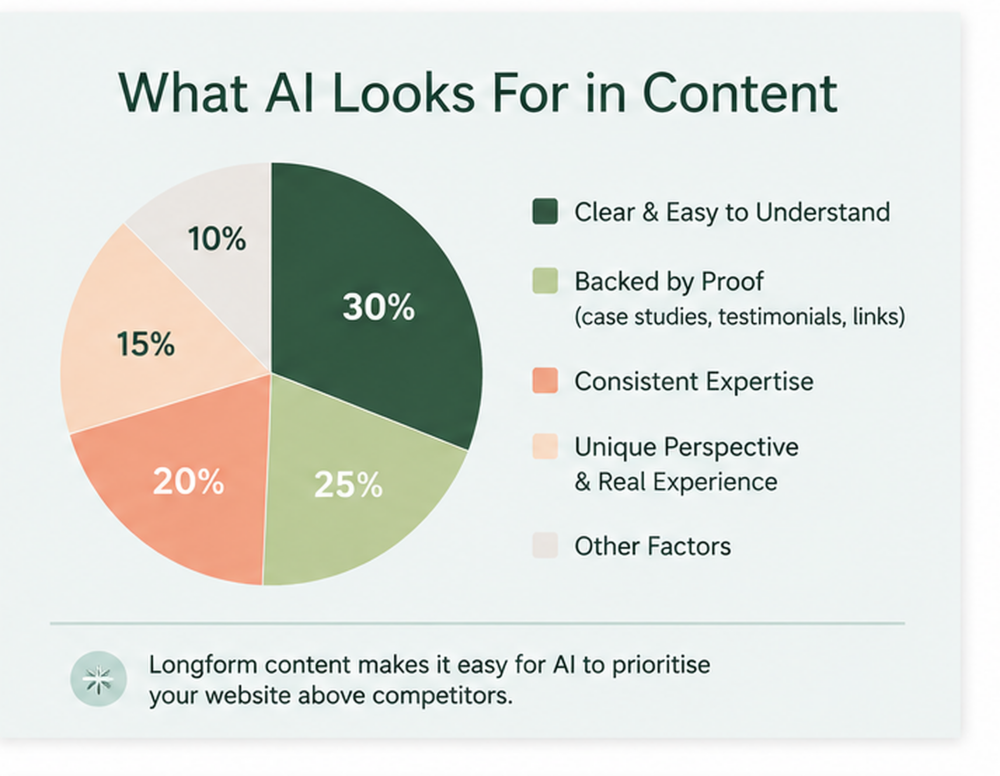
It’s all about signals: AI search is looking for the best brand behind the website to reference in its answers – so it rewards authority, trust and original insight. Think signals over keywords.
💡 Key takeaway: Think signals over keywords. AI is looking for the best brand behind the website – not just the best-optimised page.
How Is The Buying Behaviour Different?
This is an interesting phenomenon of the way search is changing.
Let’s say I’m looking to buy a new surfboard.
If I’ve done my own research by comparing different websites on Google, I’m more likely to trust my instincts and reach out or make a purchase directly on the website.
If I’ve outsourced this research to a chatbot, I’m going to be a little less confident to go with its advice without further exploration (AI has never ridden a barrel, of that I’m sure).
So even when ChatGPT recommends the best surfboard brand near me, I’m going to need more than this chatbot answer to invest hundreds of dollars.
I might find the brand on Insta, YouTube or TikTok and look for confirmation that it is indeed the right choice.
When I finally arrive on the brand’s website, as long as the content and brand voice is in line with what AI search (and the other platforms) have told me – then I will feel very confident in hitting ‘Buy’.
Think of AI search like online brand PR with the added bonus of a potential click-through, as opposed to the pure website traffic of Google search.
💡 Key takeaway: Think of AI search like online brand PR with the added bonus of a potential click-through.
How Do I Get Found On AI Search?
OK, if you’re still with me then it shows that you’re serious about getting your brand featured in AI search – let’s dive in!
1. Have a healthy, fast-loading website
Despite some tech futurists’ protests, AI and humans are not the same.
However, they do share some similarities – one being that they both hate slow, glitchy sites.
Broken links, pages that take forever to load, misleading or duplicated content all create distrust.
AI won’t recommend something that feels unreliable (and humans won’t buy from it).
✅ Actionable tip: Run your site through Google PageSpeed Insights – it’s free. Broken links and slow load times are kryptonite for both humans and AI.
2. Have an FAQ page
This is a big win and one that’s often overlooked by brands who think that their website pages do enough of the talking.
AI loves structured, question-and-answer content and this format matches how people actually talk to chatbots.
Your FAQ page is a great place to embed conversational keywords naturally (and as these sit on a major site page, they will be even more visible to Google and AI).
You can also get very granular with your responses, which is fantastic for a visitor who really wants to understand specific elements of your product or services. This provides an excellent user experience, which is a signal that AI is going to value very highly.
✅ Actionable tip: Don’t have an FAQ page? That’s your first job. Think about the 5-10 questions your clients ask before booking – and answer them properly.
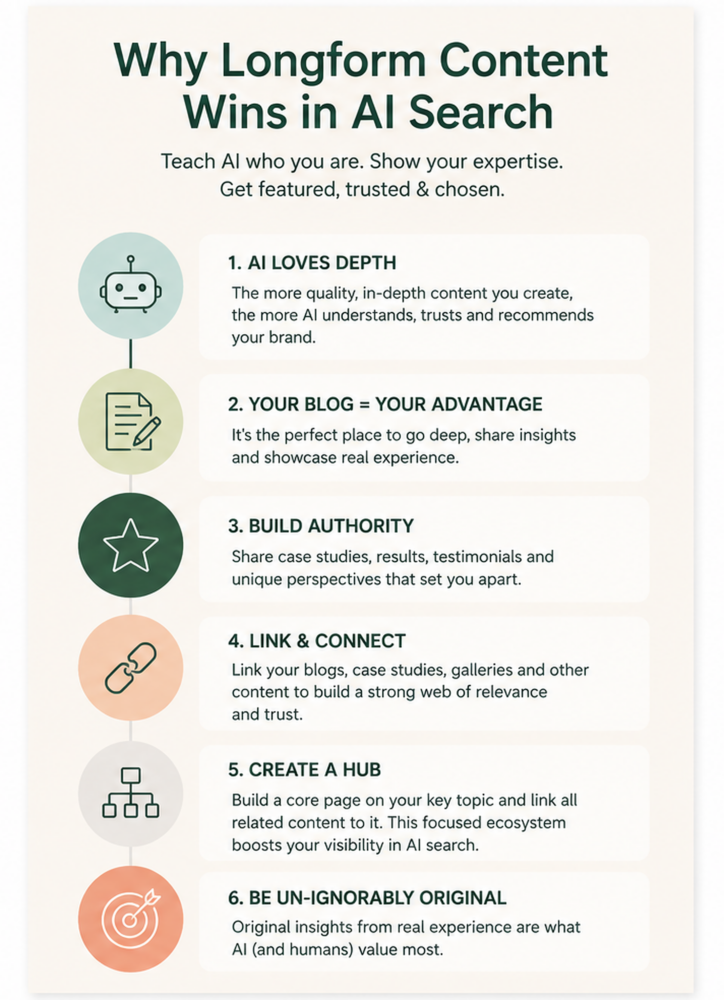
3. Write original, useful content (on your blog)
Once your FAQ page is set up, start posting AI-ready content on your blog.
Your blog is the best place to continually publish quality content that educates AI on how to rank your brand. This is because you can upload new articles as often as you like – unlike your website pages, which should usually remain untouched unless you have a rebrand or offer a new service.
Here’s how to write blogs that help AI feature your brand:
- Be original. AI-generated blogs are everywhere. You know it. I know it. And AI knows it. AI is not interested in spotlighting brands that use purely AI-generated content. (Not bragging but I called this back in 2023 – How Will AI Affect Copywriting & SEO. OK, maybe I am bragging a bit.)
- You can speed up the process by using AI for polishing, keyword placement and title headers
- Focus on what makes your brand different from the rest – unique tips, hot takes and insider information
- Publish at the same time each day, week or month – this shows AI that you are a reliable source whose audience can depend on regular content
- Include conversational keywords (see below)
- For more info, check out: Why AI Search Loves Longform Content
💡 Key takeaway: AI is not interested in spotlighting brands that use purely AI-generated content. Write it yourself – then use AI to polish.
4. Use conversational keywords
The way we talk to chatbots is different from the way we talk to Google – it’s more like a conversation.
Instead of typing “best SEO agency for photographers,” people ask questions like “I want to find an SEO agency that helps photographers get found by more clients.”
Work out what questions your audience is asking AI – then create content around those keywords.
You can slip them into a blog (like I just did), but the best approach is to build content around these searches deliberately – your FAQs, a landing page, and supporting blogs. The longform stuff is where the magic happens: you get natural variations of those conversational keywords onto your site, AI checks your authority, and starts featuring you in its answers.
Basically, you’re optimising for the whole question – not just the keyword.
Idea: Ask ChatGPT some of these questions and see who comes up. Explore their brand and work out why they’re being referenced over you. Then start creating content that separates you from them.
✅ Actionable tip: Ask ChatGPT a question your ideal client would ask. See who comes up. That’s your benchmark.
5. Get mentioned everywhere
Now that you know that AI picks up signals from everywhere (not just websites), it’s time to get sharing!
- Share your blogs on your socials and newsletter
- Duplicate your blog as a LinkedIn post – takes 5 mins, such an easy win
- Get into Reddit threads and Facebook groups where your ideal clients hang out – share advice and relevant links to your blog and website
- Post YouTube content – it’s a lot easier than it might seem and its value compounds over time (like SEO)
Think of content publishing like a PR campaign for your brand – the more buzz around your website, the higher the chance of AI noticing you.
✅ Actionable tip: Duplicate your next blog as a LinkedIn post. Takes 5 minutes. One of the easiest wins on this list.
6. If you’re ranking on Google, you’re already ahead
SEO is still very important, even in the world of AI search.
Good rankings = trust signals = AI is more likely to recommend you.
So even if you’ve never optimised for AI search, if you have a decent SEO strategy in place then you’re not starting from zero.
💡 Key takeaway: Good SEO and AI visibility go hand in hand. You’re not starting over – you’re building on what you already have.
7. Schema markup
OK, I know I said that this was a beginner’s guide… Fair warning, this one is intermediate to advanced. But I want to mention it as getting it wrong can be kryptonite for AI search.
Schema markup is invisible code that labels your content for search engines – think of it as a nametag for your website.
The clearer you make it, the easier it is for AI to reference you in its answers.
Check your website platform’s SEO settings – most have it built in, and if you’re on WordPress, Yoast takes care of it automatically. Or say hi and we’ll take a look for you.
💡 Key takeaway: Schema markup is a nametag for your website. Most platforms have it built in – just check your SEO settings, or ask your web developer.
What Now?
Search is evolving faster than ever – but if that feels scary, flip it. It’s actually exciting. New platforms mean new ways to get discovered, and right now most of your competitors are either hoping ChatGPT magically notices them despite zero effort, or quietly hoping AI search just… goes away.
Spoiler: neither is happening.
If you’re a quality brand that does good work, this is an opportunity not a threat.
Do you want your brand to show up when people search ChatGPT?
Check out our AI Visibility System – built to get your brand featured first in chatbot answers…
Or send a message with a link to your website on our Contact page or on Insta and we’ll tell you where to start.